England Without English: The Rise of the Vernacular in Medieval England
Introduction
From the late twelfth century, Middle English was the first language for most of the population. However, it was rarely used in writing, with Latin and French being preferred. This began to change by the fourteenth century, when written English became more culturally significant. Whilst English never completely replaced Latin and French in this period, its rapid rise in popularity is certainly clear. Two key reasons for this are a growth in national identity and the need for wider access to knowledge across the English population. This article will discuss both of these causes for the increased use of the vernacular across three sectors of society: the literary, the royal, and the legal.
The Rise of English Literature
The growth of English in literature, which occurred in the fourteenth century, was a challenging process, as English had no literary form of its own and had to be standardised to a functional degree. Writers attempted to overcome these issues by implementing loan-words and literary structures from French or Latin within English texts. Notably, Geoffrey Chaucer introduced two thousand new words into the English language, which were already used in Anglo-Norman and Latin. Thus, it is clear that writing in the vernacular was no natural development, especially when one considers the sheer effort that went into the process. By translating words from more prestigious languages into English, there is a sense that the vernacular in itself is unsuitable for literature. This suggests that authors like Chaucer were trying to enhance the status of English, perhaps to put English writings on par with the likes of French or Italian literature. By moulding English to their needs, they created a written language that was separate from French, the language of England’s rival, as well as being more widely understood nationwide. Therefore, these written texts act as a symbol of English unity.

However, the choices made by many writers demonstrate the desire for wider access to knowledge as the main reason behind their use of English. Many English writers detail their motives behind their language choice in preface to their works. This is seen in John Trevisa’s Dialogue Between a Lord and a Clerk, where he gives his reason for translating the Polychronicon: “I wolde have thees bokes of cronicles translated out of Latyn into Englisshe, for the moo men shuld hem understonde and have thereof kunnyng, informacioun and lore.” This shows that Trevisa used English for increased understanding and wider access to information. This idea is supported by the use of Latin glosses and directional notes on texts by the likes of Chaucer and Gower. These annotations imply that the writers still intended their works to be read by people who knew Latin. However, the English main body of text suggests that these works were meant to be read aloud. This implies that a key motive behind the use of the vernacular was for wider accessibility, as the majority of the population consumed information aurally in their native language.
This wider access was also a key aspect of the heretical movement, Lollardy, led by John Wycliffe, as lollards aimed to translate religious texts into English. The most popular of these was the Bible (known as the Wycliffite Bible), with over 250 copies in circulation at this time, compared to 64 of The Canterbury Tales. This suggests a bottom-up desire for an increased use of English, with production of English books being driven by their audience which was growing rapidly in the 1380s. Since the English Bible was one of the most popular texts in England at the time, this implies that ordinary people yearned for greater understanding, as religion was central to their lives.
The English Monarchy and the Need for an English Identity
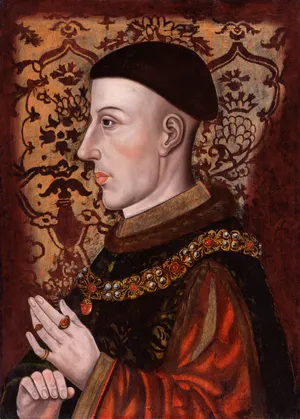
The Crown often supported the rise of English due to their need for an identity separate from France. From Edward III’s reign (1327–1377), English kings laid claim to the French throne, leading to the Hundred Years’ War. As France was the enemy, it was beneficial to remove the widespread French influence among English culture. In the fourteenth century, the Crown stated that France was trying to extinguish the English language altogether, demonstrating the significance that was placed on language as a sign of national identity. This was partly the reason behind the Crown’s support of English writers. The French language needed to be removed in order to create an English literary, and therefore national, identity. Henry V was supportive of English writers, having commissioned Lydgate’s Troy Book, for example. However, it was Chaucer that the Crown especially loved. This speaks to another motive behind their advocation for English, which was to fit their own image. Chaucer’s works were reasonably politically neutral, steering clear of the controversial debates that other writers of his time discussed. He allowed the Crown to reinforce the status quo, whilst also trying to get English recognised on an international level.
Scholars often pinpoint Henry V’s reign as a turning point for the rise of English. A key marker of this was his switch to English in his signet letters. This was one of many language changes made by the king following his success at Agincourt in 1415, which shows how a growing sense of nationalism prompted a creation of English identity centred around language. During Henry VI’s minority, the signet letters reverted back to French, but were written in English again once Henry reached maturity. Furthermore, petitions answered by the king were often written in English, whereas those considered by councillors were in Latin or French. This suggests a more top-down process, with a clear link between the king’s personal control and a growing use of English. The creation of a more solid national identity was also a player here. Henry VI was not particularly interested in continuing the war, often being described as timid and passive. This, along with military and diplomatic failures, meant that England was becoming increasingly isolated from France. Therefore, there was a retreat from French influence, as France was no longer seen as politically significant in England. The royal concern over the French matter certainly points towards national identity being the key driver of their adoption of English.
The Vernacular in Law
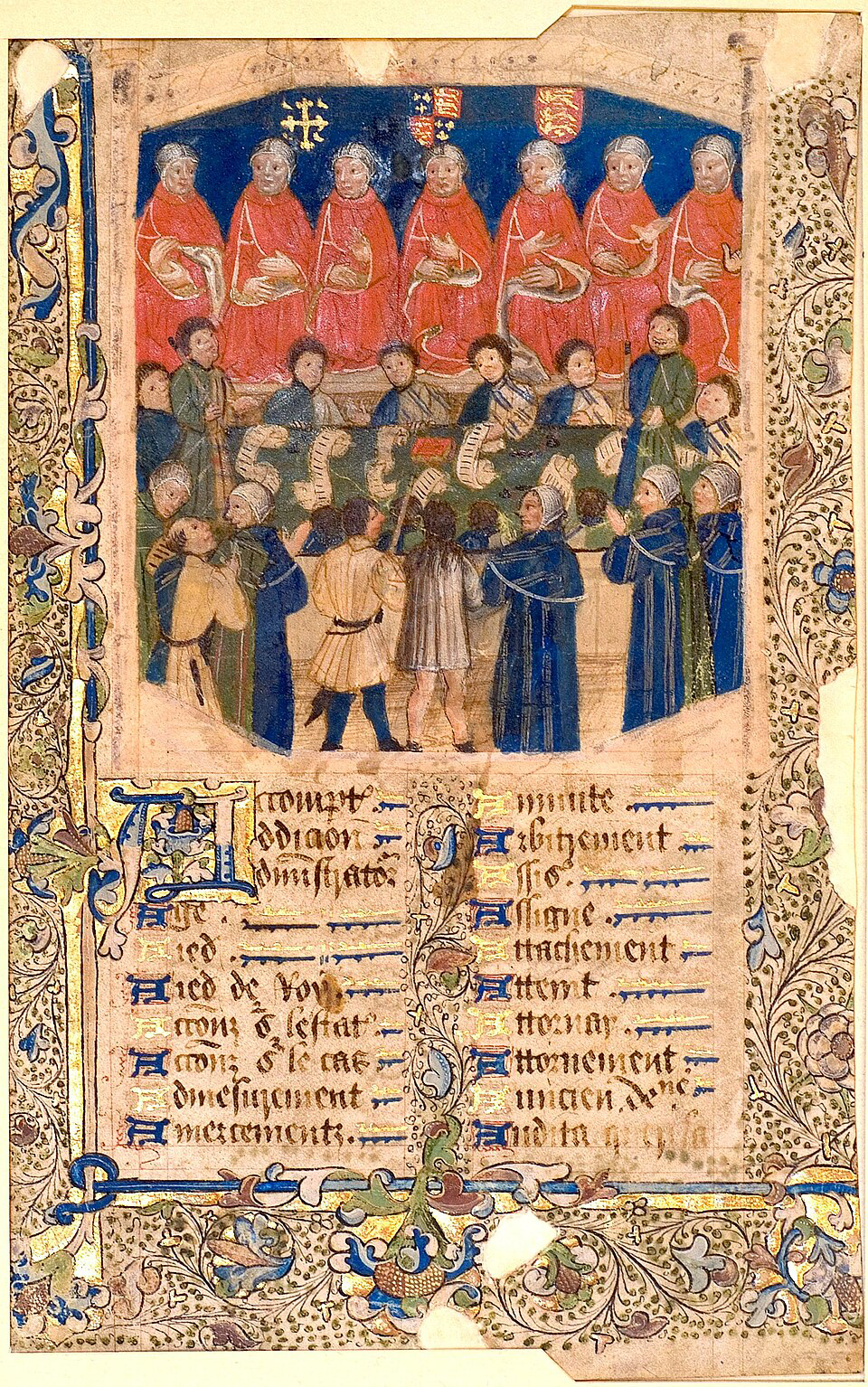
The growth of English in the legal sector aimed at supporting ordinary people’s understanding, as it was mostly the spoken language that changed. Using the vernacular in the legal sphere was challenging, as there were no equivalents to many French legal terms. However, little attempt was made to translate these words, so the use of English in law remained quite limited. The courts seemed concerned that ordinary people did not understand the legal system in French. As stated in the 1362 Statute of Pleading, which imposed that the spoken language of the courts must from then on be English, French was “very much unknown in the said realm,” so much so that people “have no understanding or knowledge of what is said for them or against them.” However, whether there was a genuine desire to help the common people through this language shift is uncertain. The Statute was issued alongside celebrations for Edward III’s birthday, almost like a side-thought, as it must have been overshadowed by the festivities. Furthermore, it was harder to monitor the use of a spoken language as opposed to a written one. Thus, even in the short term, the continued use of English seemed precarious, implying that the Statute was more symbolic than genuine and perhaps tried to show how the king was on his people’s side.
Written English was used in courts to transcribe the vernacular more accurately. This demonstrates how, in some cases, it was better for everyone to use one language, and English was the language known by most of the population. Therefore, the common people had more authority over the legal process. However, the idea of national identity was an underlying cause for the increased use of English. Latin remained in use more widely in documents, relatively unaffected by the rise of English. Conversely, documents that had always been written in French were impacted most by vernacularisation. This removal of French in law courts reflects a wider move away from French influence due to the Hundred Years’ War.
Conclusion
The vernacular appeared much more frequently in written and professional culture in the later medieval period, primarily due to the rise of an English identity and the growing desire for access to knowledge in the lower sectors of society. The growth in national identity was particularly important for the Crown, who mostly used English for their own, often nationalistic, purposes, as foreign policy was evidently a pressing matter. This was pushed from the top down onto others, such as writers and lawyers. However, both the literary and legal sectors increased their use of English more because of the common people’s need for better understanding. It was the English Bible, a book central to many lives, that was the most popular. Most lawyers seemed to push for spoken English in courts, at least on a surface level, which people were more likely to understand over written text. It was ultimately wider access to knowledge that was the key driver behind the rise of Middle English.
Written by Emma Bassett
Bibliography
Images
Unknown (c. 1400). Geoffrey Chaucer: The Canterbury Tales. Encyclopaedia Britannica. Accessed 26 July, 2025. https://www.britannica.com/art/English-literature/Chaucer-and-Gower.
Unknown. (1412). Chaucer manuscript portrait (détail).jpeg. Wikimedia Commons. Accessed 26 July, 2025. https://commons.wikimedia.org/wiki/File:Chaucer_manuscrit_portrait_(d%C3%A9tail).jpeg.
.jpeg)
Unknown. (c. 1500–1600). Henry V of England. World History Encyclopedia. Accessed 26 July, 2025. https://www.worldhistory.org/image/11813/henry-v-of-england/.
Unknown. (c. 1460). Common Pleas.JPG. Wikimedia Commons. Accessed 26 July, 2025. https://commons.wikimedia.org/wiki/File:Common_Pleas.JPG.

Primary
Statute of Pleading, 1362. In W. M. Ormrod, “The Use of English: Language, Law, and Political Culture in Fourteenth-Century England,” Speculum 78, no. 3 (2003), 756–57.
Trevisa, John. Dialogue Between a Lord and a Clerk. In The idea of the vernacular: An anthology of Middle English literary theory, 1280-1520, edited by Jocelyn Wogan-Browne a.o.; With contributions from participants in the Cardiff Conferences on Medieval Translation: Ian R. Johnson a.o., 131–34. University Park, PA: Pennsylvania State University Press, 1999.
Secondary
Aston, M. E. “Lollardy and Sedition 1381–1431.” Past & Present, no. 17 (1960): 1–44.
Catto, Jeremy. “Written English: The Making of the Language 1370–1400.” Past and Present 179, no. 1 (2003): 24–59.
Dodd, Gwilym. “The Spread of English in the Records of Central Government, 1400–1430.” In Vernacularity in England and Wales, c. 1300–1550, edited by Elizabeth Salter and Helen Wicker, 225–66. Turnhout, Belgium: Brepols Publishers, 2011.
Dodd, Gwilym. “The Rise of English, the Decline of French: Supplications to the English Crown, c. 1420–1450.” Speculum 86, no. 1 (2011): 117–150.
Fisher, John H. “A Language Policy for Lancastrian England.” PMLA 107, no. 5 (1992): 1168–80.
Johnson, Tom. Law in Common: Legal Cultures in Late-Medieval England. Oxford: Oxford University Press, 2020.
Ormrod, W. M. “The Use of English: Language, Law, and Political Culture in Fourteenth-Century England.” Speculum 78, no. 3 (2003): 750–787.
Rothwell, William. “Aspects of Lexical and Morphosyntactical Mixing in the Languages of Medieval England.” In Multilingualism in Later Medieval Britain, edited by D. A. Trotter, 213–32. Cambridge: D. S. Brewer, 2000.
Scase, Wendy. “Re-inventing the vernacular: Middle English language and its literature.” In The Cambridge Companion to Medieval English Literature 1100–1500, edited by Larry Scanlon, 11–24. Cambridge: Cambridge University Press, 2009.
Watson, Nicholas. “The Politics of Middle English Writing.” In The idea of the vernacular: An anthology of Middle English literary theory, 1280–1520, edited by Jocelyn Wogan-Browne a.o.; With contributions from participants in the Cardiff Conferences on Medieval Translation: Ian R. Johnson a.o., 331–52. University Park, PA: Pennsylvania State University Press, 1999.