The Pig’s Peasant: Swine Herding in Anglo-Saxon England
Despite their relatively small scale, the pigs of Anglo-Saxon England signified a number of implications for those who reared and wrote about them. Whilst we do not have a vast array of sources from the Anglo-Saxon period in comparison to other medieval periods, we do have access to some documentation such as the Ely Memoranda, the Rectitudines Singularum Personarum, and the Hatfield List. These sources provide us with the opportunity to begin to understand how swine existed in this period as unique economic goods, cultural exemplars and societal signifiers; it can be argued that pigs had greater economic and textual significance than most other animals, such as cows, sheep and deer.
The Pig
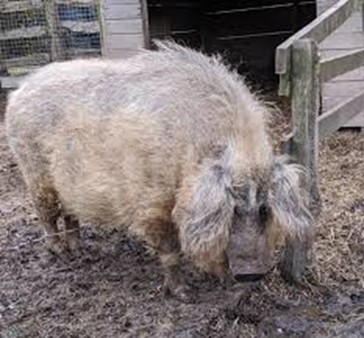
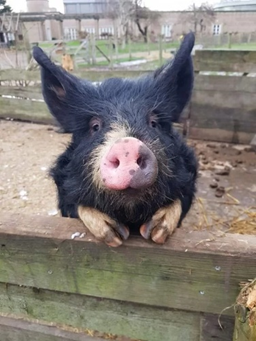
The early medieval pig was quite the far cry from its bare, fattened modern counterpart; their domesticated pigs were typically grey and small in comparison. Jarrow Hall’s “Living History Farmhouses” in Newcastle, a living museum of farm animals from history, exhibit pigs that give us an idea of how they looked, which to our modern eyes look like a hybrid between the Tamworth breed and the Wild Boar (Fig.1). Additionally, pigs made up a much smaller proportion of the animal population compared to today. Studies of animal bones from the east and south-east counties show approximate ratios of cattle, sheep, and pigs as 48:42:9 respectively. Although such surveys suggest that the percentage of pig farming had grown slightly since the late Roman period, the number of domesticated pigs remained relatively low.
An important detail of pig farming in this period, however, is its concentration and location. When analysing the surveys we can see that, whilst pig bone assemblages were infrequent, those that were found tended to be substantial and homogenous; one such site was Wicken Bonhunt in Essex. The findings at Bonhunt sheds light on a potential specialisation needed when rearing pigs. Compared to sheep and cattle during this time, pigs seemed to require an emphasised separation from regular farming practice and planning; indeed, it may suggest that pigs were only invested in larger, concentrated populations where the environment and labour were most viable.
The areas in question may provide further exploration when we consider how pigs were actually managed. Unlike other farm animals in the period, pigs were semi-feral, in the sense that swineherds would often let their pigs loose in forests, so that they could scavenge for food from the rich forest floors, which meant reduced costs for food. This process is called pannage, and is still used today albeit in much smaller quantities. Pannage as a form of swine farming appears to have been an essential part of the process during the Anglo-Saxon period. It seems that most large assemblages of pig bones were found near well-wooded areas, which would have been useful resources for any swineherd; this can explain why the pigs were in such concentrated sizes. The more successful swineherds would have been able to reduce costs for food and continue to grow their numbers of pigs as much as the wooded areas could provide. Pannage was such a concern for early medieval farming that several Anglo-Saxon documents record the ownership of land in conjunction with pigs such as the Domesday Book record for Hatfield, which lists woodland for 2000 pigs specifically. This can explain their relatively small, but nevertheless specialised, populations.
Overall, the zooarchaeological evidence makes it clear that pigs in the Anglo-Saxon period were specialised farm animals, requiring a surprising amount of effort to keep. Compared to sheep and cows, they were much smaller populations but, as evidenced by the Domesday Book and bone assemblages of Wicken Bonhunt, they were still afforded a great deal of attention in how their populations were organised and placed by the managing classes.
The Peasant
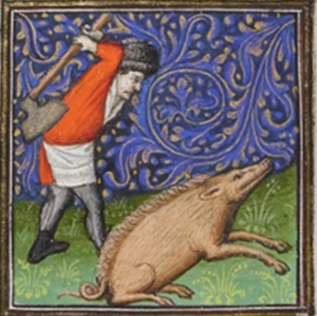
We can see this specialisation further when we consider the people whose role it was to keep, protect, and manage the pigs (the swineherds) who were provided personal attention and identification. A list of geburs (Old English dwellers, unfree peasants with servitude to a location) records a certain swineherd, Werlaf, who “kept the grey pigs.” This detail is unusual for unfree people in the Anglo-Saxon period, who were usually identified by their location of possession or a relative. Werlaf, however, is identified by a number of things: relation to his son, Werstan; the land of Hatfield that he was possessed by, and his keeping of the grey pigs. In a list of several dozen people, only two other people are given any similar detail of their role: a beekeeper and an archer. We can see, then, that pigs, despite – or maybe because of – their small population and their required specialisation of farming, afforded some people with a certain status of identification. The role is not necessarily celebrated, but it is apparently important enough that it can essentially summarise a person’s entire identity. He was not a free peasant, and so, to the legislators of the list, his ability to stand out in society comes from working with a certain farm animal. It’s worth noting also that cowherds and shepherds are rarely afforded such a status.
The Rectudines Singularum Personam – an Anglo-Saxon document of laws and responsibilities for people – provides considerable insight into the swineherd’s status as an important worker. It states that the swineherd of an estate, much like the beekeeper, “must be always available for any work, and be provided with a horse for the lord’s needs,” which tells us that the role took a considerable amount of attention. It may seem odd that a person who simply manages an estate’s pigs must be available at any time and be provided with a horse assumedly to fulfil such summons at a moment’s notice. The direct connection to his lord too, in conjunction with the same attention afforded to the beekeeper, may allude further to an idea that the swineherd was an important role in this period as a result of their connection to such a specialised animal. The peasant’s connection to the pigs, thus, affords him a higher role, provided with further boons and relation to their lord: a promoted position above other peasants, dutifully bound to the higher classes.
Summarily, the swineherd was a specialised role with administrative focus despite their lower statuses and responsibilities. It is, however, those responsibilities recorded by the Rectitudines Singularum Personarum that make them so interesting. The elite of the Anglo-Saxon period were related to the swineherds, as one appeared to need information from the other in order to manage the swine properly. In essence, the unique nature of pig farming meant that the people who operated in that industry stood out by the mechanisms of Anglo-Saxon management legislation.
The Price
The attention for pigs can be further explained by their economic value as market goods rather than another method for subsistence. The historian Pam Crabtree argued that the dominance of skulls and jaw bones found in Wicken Bonhunt signified that the meat-bearing bones of the pigs had been exported elsewhere. In a sense, this perhaps means that Wicken Bonhunt was an area of specialised pig farming where the pigs were also slaughtered with their meat exported elsewhere. To what extent, and how far these meats reached, we cannot be certain, but it demonstrates that pork production in Anglo-Saxon England may have been an emerging industry, with produce and export in mind, compared to other methods of farming.
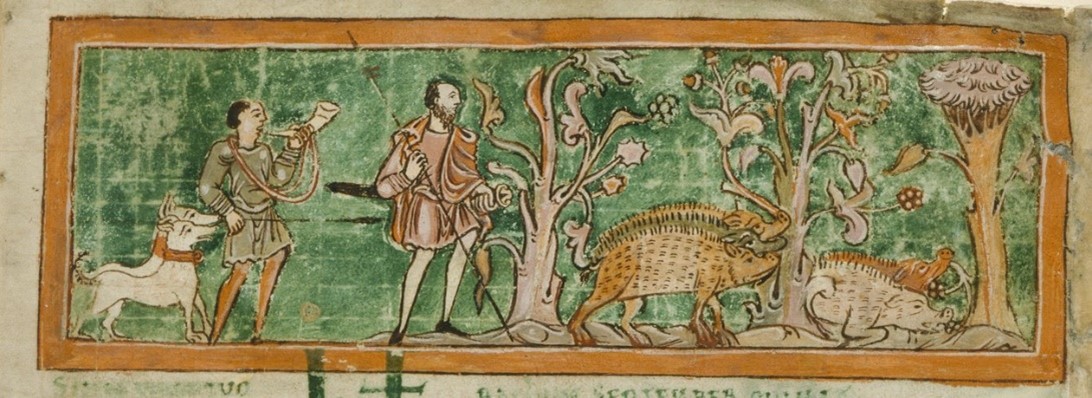
A memorandum from Ely provides good evidence that exportation was available in the country, and to considerable distances. The text records donations from the Abbey of Ely and its owned territories, such as Hatfield providing 30 full-grown swine, each one worth 6 pence, over to the community of Thorney, almost seventy miles away! Many other such donations of pigs and swineherds were also recorded, with large numbers of pigs transported to other areas of the eastern counties. The processes of such feats are not provided, but, as each pig and swineherd are given value and numbers, it is clear that the provisions and values of pigs were important details to record. Was this to demonstrate piety, economic superiority, or simply bureaucracy? We cannot be certain. It could be a number of factors, but the overwhelming prevalence of swine in the other memoranda of Ely too provides further implication that, in the eastern counties, pig farming was a growing economic industry. Like the Hatfield list, the Ely Memoranda has names to those responsible for the pigs at Hatfield, mentioning an ‘Ælfwold’ and an ‘Ælfnoth’ in charge of some of the swine for donation. Overall, from this we can infer a great deal of complexity about the swine industry in Anglo-Saxon England that offered those involved in the industry notable status and prosperity, including the dutiful, named swineherds and the landholders who owned the valuable swine.
Conclusion
We begin to see that during Anglo-Saxon England swineherds and their pigs were part of a growing agricultural and economic society in a period that rarely afforded them. From previous sources we can see that whether the swineherd was a free man or not, his role was afforded great regulation and attention from the higher classes. The very existence of pig rearing, whether that it is in Wicken Bonhunt or Ely, was dependent on the whims of the elite. Further studies will perhaps show the kind of relationship that swineherds, pigs, agriculture and the economy had in a growing society such as the Anglo-Saxon south.
Written by Frederick Upton
Bibliography
Images
Cotton MS Tiberius B V/1 f.7.
Trinity MS B.11.31.
Sources
Crabtree, P. J., ‘Sheep, Horses, Swine and Kine: A Zooarchaeological Perspective on the Anglo-Saxon Settlement of England Special Studies,’ in Journal of field archaeology 16 (Boston, 1989), p.205-213.
Domesday Book, Cotton MS Tiberius A.VI.
Ely Memoranda, ADD MS 61735.
Faith, R., The English Peasantry and the Growth of Lordship (London, 1997).
Hatfield List, British Library, MS Cotton Tiberius B.v, vol. 1, fol. 76v.
McKarracher, M., Farming transformed in Anglo-Saxon England: agriculture in the long eighth century (Oxford, 2018).
Naismith, R., ‘The Ely memoranda and the economy of the late Anglo-Saxon fenland’ in Anglo-Saxon England 45 (Cambridge, 2016), p.333-377.
Pelteret, D. A. E., ‘Two Old English Lists of Serfs’, in Mediaeval Studies 48 (Brepols, 1986).
Rectitudines Singularum Personam, Corpus Christi College, Cambridge MS 383.
Wesley, I., Anglo Saxon farming in the East Meon Hundred, (East Meon History Group).
Williams, J. T., ‘For the Sake of Bravado in the Wilderness: Confronting the Bestial in Anglo-Saxon Warfare’, in Representing Beasts in Early Medieval England and Scandinavia (Boydell, 2015), pp. 176-204.
Website for Jarrow Hall Living Farm, https://jarrowhall.com/anglo-saxon-farm-and-village/.