Jerusalem: Pride Amidst Two Layers of Tension and Violence
Introduction
The Jerusalem Pride Parade has taken place annually since 2002. It is organised by the Jerusalem Open House (JOH) – an Israeli organisation supporting the LGBTQ+ community in Jerusalem. The event has substantially transformed throughout the years. The earlier parades were smaller, with only a few hundred participants; some later parades contained dozens of thousands of participants. In the early parades, the participants had marched without intense security and without any substantial separation from the surrounding area; since 2016, the parade has become an isolated bubble, surrounded by barriers, watch towers, and thousands of police officers guarding it. The dominance of fringe culture, such as left-wing and feminist activists, characterised the earlier parades; the later parades became more commercialised, featuring celebrities and politicians – including those from mainstream parliamentary parties.
This transformation marks the progress of gay rights in Israel. It is the purpose of this article to describe some of the contexts within which this progress has occurred, specifically in Jerusalem. I will focus on two such contexts: the tensions within the Jewish-Israeli society, and the Israeli state violence against the Palestinians. I will also show how these two layers of tension are intertwined.
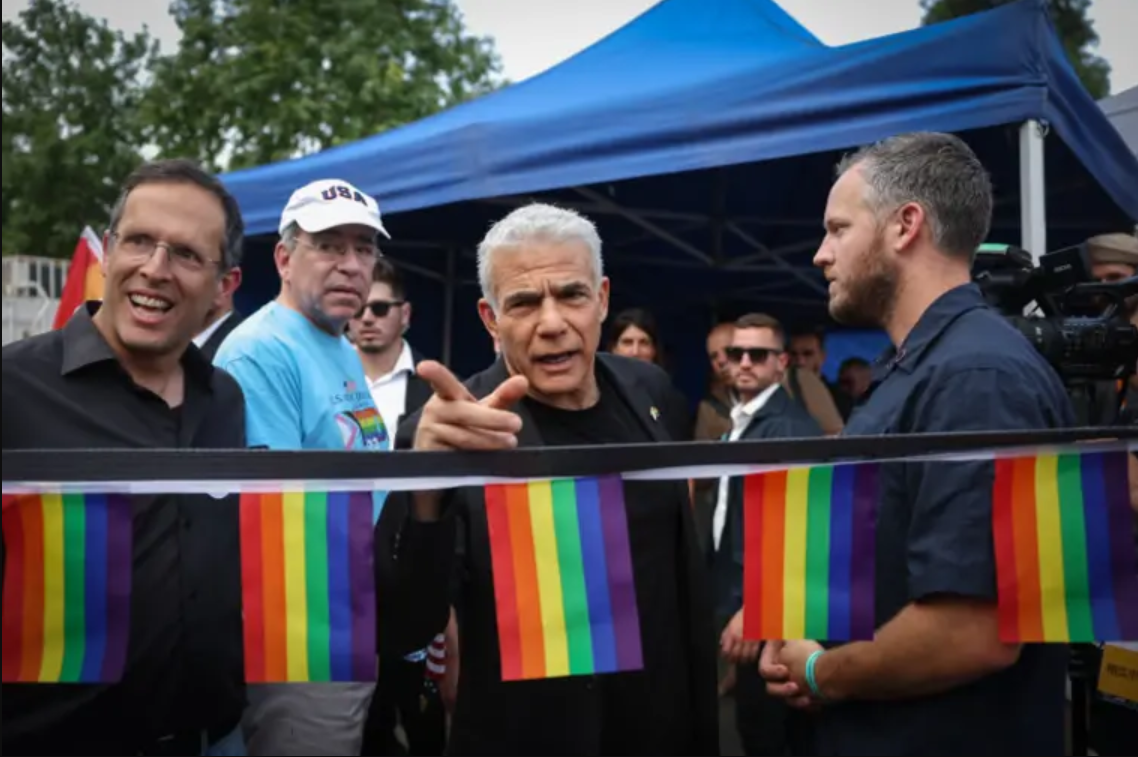
Tensions within the Jewish-Israeli Society
The parade takes place amidst at least two layers of tension. The first layer is the controversy within the Jewish-Israeli society regarding queerness in public, specifically in Jerusalem – where most residents are religious. This tension came to a head in 2005 when the extremist activist Yishai Schlissel stabbed and injured a few of the participants during the parade. A decade later, shortly after being released from prison, Schlissel broke into the parade again and stabbed a few more participants. This time, the consequences were much more severe, as Shira Banki, one of his victims, died from her injury shortly after the stabbing.
The violent resistance failed to stop the parade from taking place. The murder was widely condemned by Israeli political leaders, including the leaders of Jewish ultra-orthodox parties. In 2016, following the murder, the parade more than doubled its size to 25,000 participants, compared to around 10,000 participants in 2015. In this case, violence not only did not achieve its goal but also yielded the opposite effect.
The progress of the queer struggle in Jerusalem is reflected not only on the ground but also in legal status and public discourse. In 2008, the Israeli Supreme Court resolution rejected various petitions calling for the court to ban the parade, stating that: “gathering and marching on the street is a natural and accepted way of implementing the constitutional right of freedom of expression, which is in the higher standard of human rights” (free translation from Hebrew by me). This resolution anchored the status of the parade within Israeli law, holding back attempts by politicians, members of the municipality council, and activists to cancel it.
It is worth mentioning the name of the lawyer who represented the petitioners in 2008: Itamar Ben-Gvir – a far-right activist who later became the minister of national security in 2022. Alongside the mainstreaming of the queer community, Ben-Gvir and other far-right activists – who were once considered wild thorns in Israeli society – have become mainstream as well. This demonstrates that history can develop dialectically, progressing in two opposing directions at the same time. Gay rights are only one flow in recent Israeli history; they interact with many other flows, and this interaction should be analysed as a whole to understand each flow in particular. One cannot understand the queer struggle in Israel without contextualising it.
The goal of the next section is to briefly contextualise gay rights in Israel within the broader Israeli-Palestinian conflict.
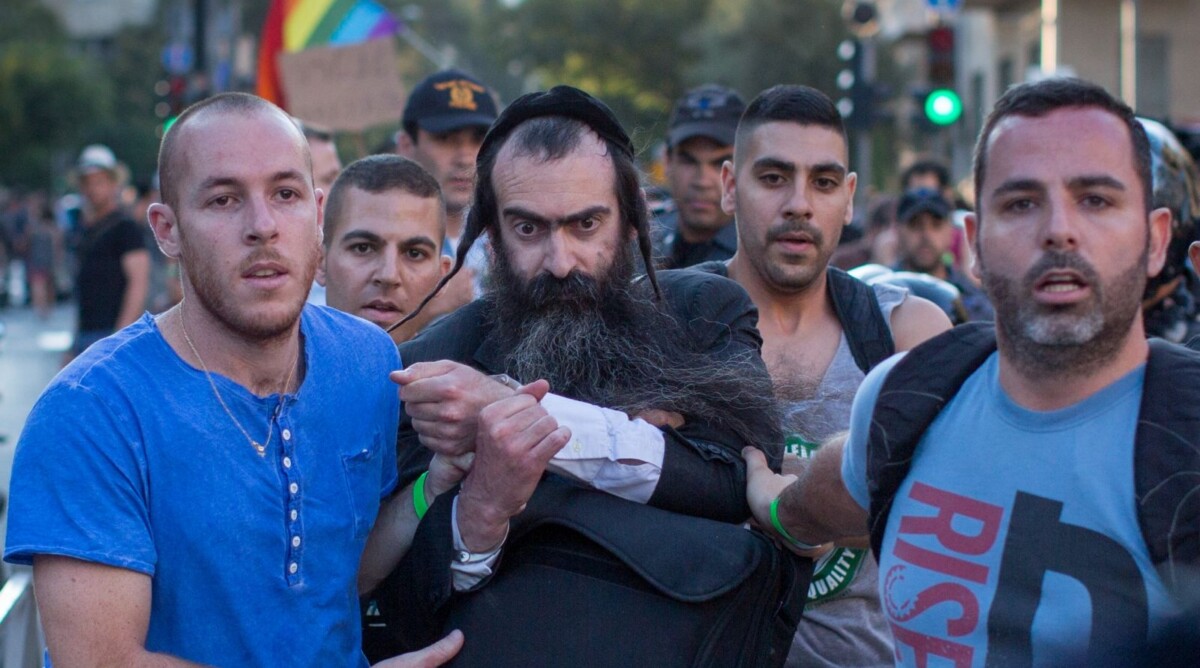
Pinkwashing: The Queer Struggle and Israeli State Violence
Pinkwashing is a critical term describing the exploitation of gay rights to distract from or justify the violation of human rights against other groups, in this case, the Palestinian people. Derived from the concept of Greenwashing – in which companies present themselves as eco-friendly to gain profit – Pinkwashing uses the LGBTQ+ community as a tool for promoting (what is perceived by the critics as) immoral policies.
Over the past few years, Israel has used gay rights to improve its international reputation in various ways. It endorsed this policy as part of the Brand Israel program, founded and promoted by the Ministry of Foreign Affairs in 2005. From a critical point of view, branding Israel by emphasising the progress of gay rights is seen as a form of institutional Pinkwashing.
However, Pinkwashing is not merely practised by heterosexual-majority institutions; it also comes from within the Israeli LGBTQ+ community. To mention just one example, an iconic image was published last year by an Israeli soldier in Gaza, where he is seen carrying the rainbow flag. The flag contains the words “in the name of love” written in Hebrew, English, and Arabic. In the background, one can see some of the mass destruction caused by the Israeli army in Gaza. It was the soldier’s initiative to carry the flag, not the result of official army policy. From a critical point of view, such actions are interpreted within the context of colonial violence and propaganda.
Since its establishment in 2002, queer activists in Jerusalem tackled Pinkwashing by demonstrating against the Israeli occupation inside the parade. Activists of the anarcho-queer group Black Laundry – which was established during the second Palestinian Intifada and remained active during the first years of the new millenium – marched together annually in support of Palestinian rights. The Black Laundry group no longer exists, but activists still gather at the annual parade in support of Palestinian rights. Their demonstration is twofold; it is directed both at the outside patriarchal and heteronormative world and at the Israeli LGBTQ+ community, which is perceived as compliant with the state violence and oppression of the Palestinians.
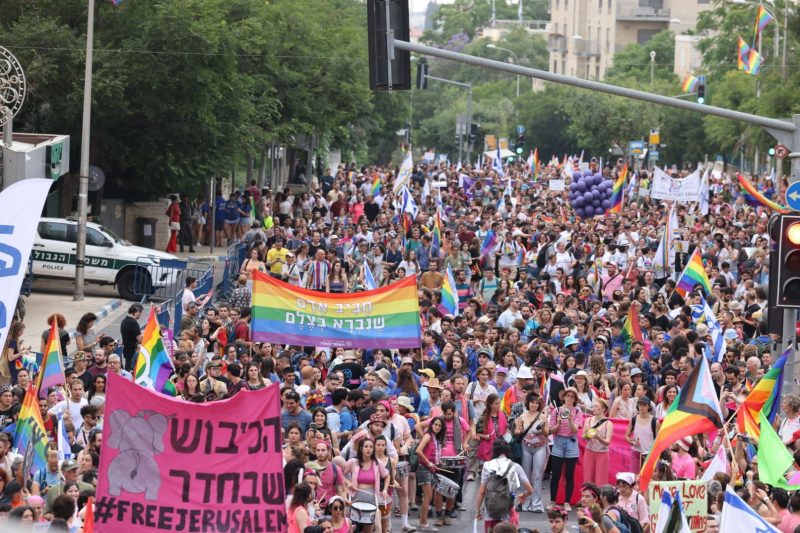
Tackling Patriarchy within the Palestinian Society
Despite this criticism, it is a fact that Israel has endorsed a much more liberal approach to LGBTQ+ rights, compared to the Palestinian society, where sexuality in general, and homosexuality in particular, is still taboo. Pinkwashing is a problem, yet there are many more pink spaces in Israeli society compared to the Palestinian society. Some of them are accessible to some Palestinians, especially those who hold Israeli citizenship or residency. For example, the Beit al-Mim project of the Israeli Aguda provides supporting services to Palestinian citizens of Israel, including a mental health hotline in Arabic. In 2020, Julia Zaher, a Palestinian citizen of Israel and the owner and CEO of the well-known Al Arz Tahini brand, donated funds to help establish this hotline. In response, Zaher’s Al Arz Tahini faced a boycott from Palestinian communities and individuals in Israel. Unlike Boycott, Divestment and Sanctions (BDS) campaigns directed at Israeli products, this boycott was initiated not because of the cooperation with an Israeli organization, but because of the very attempt to acknowledge and support LGBTQ+ individuals. These dynamics show how challenging the situation for queer Palestinians is.
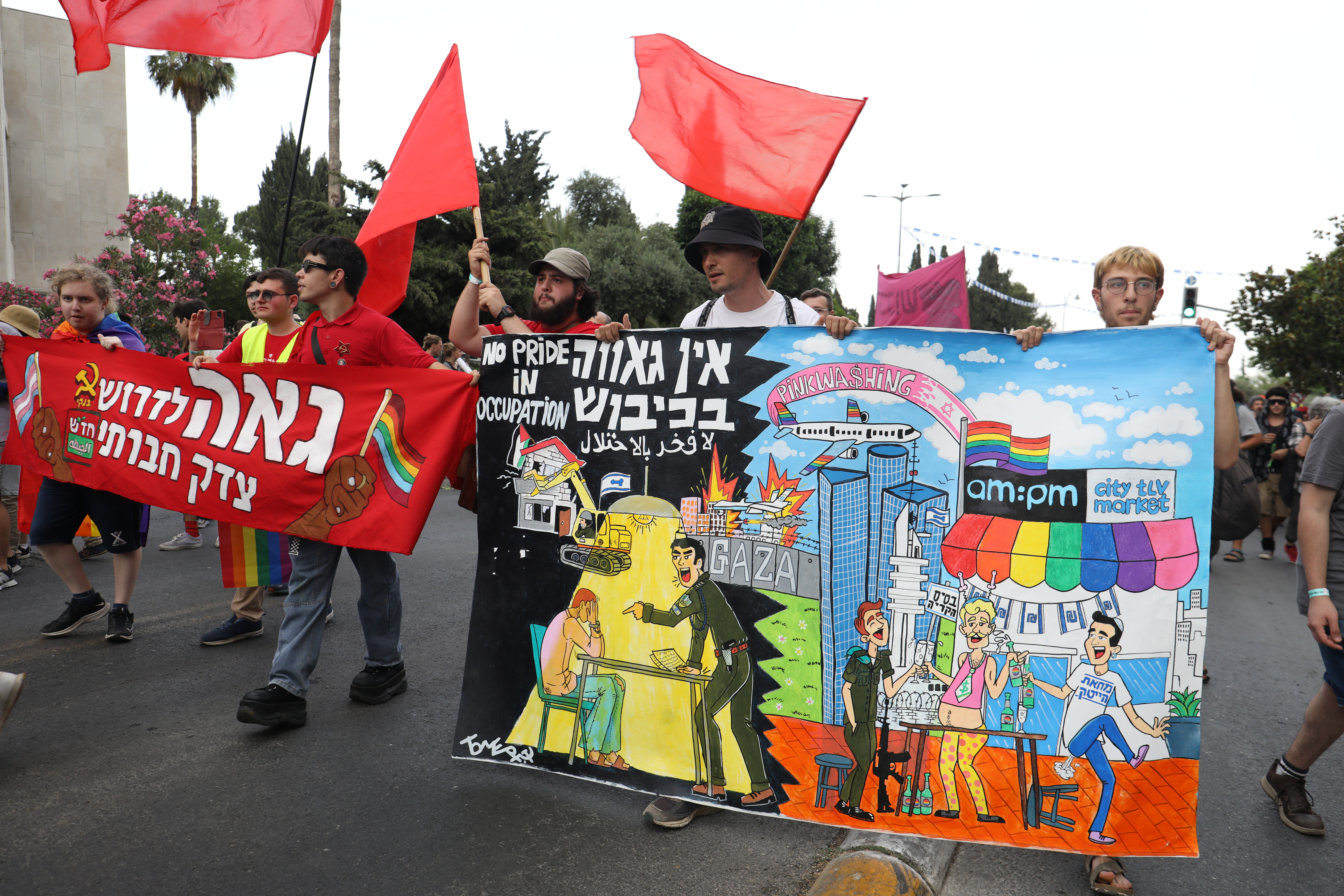
Queer activists in Israel/Palestine face the dilemma of how to promote gay liberation in Israel without Pinkwashing or damaging the interest of queer Palestinians. In Palestinian society, Israel is perceived as a colonial and oppressive entity that represents foreign interests. Therefore, the progress of gay rights in Israel can sometimes have detrimental consequences on the Palestinian queer community. Joseph Massed analyses this problem within a broader context, arguing that categories such as gay and lesbian are unfitting for the Arab world. Accordingly, he perceives the international campaign for queer liberation as analogous to colonial-missionary campaigns. Within the Israeli-Palestinian context, the progress of gay rights in Israel can create repulsion and antagonism, thereby deepening the patriarchy within Palestinian society.
However, Israeli and Palestinian societies are not completely separated, and, as described above, some of the liberal spaces inside Israel are accessible to some Palestinians as well. Despite the (or perhaps as part of the) colonial dynamics on the ground, some Palestinians gain access to pink spaces in Israel. Other Palestinian organizations such as AlQaws operate without any contact with the Israeli authorities. While still considered taboo in much of Palestinian society, Palestinian queer activists work to empower LGBTQ+ individuals and support social change.
Conclusion
In this article, I described some of the historical developments and political contexts of the gay pride parade in Jerusalem. Many questions are left unanswered, but the main purpose here is to raise the questions, not to answer them. Does the Israeli queer community serve some broader colonial practices, creating tension and rooting patriarchy in the Palestinian society? What is the role of the queer community in Israel in the reality of occupation and state violence, especially now when many parts of Gaza have been completely destroyed? At what point does gay rights activism become Pinkwashing? These are all theoretical questions. For me, however, this is not just theory, but also a practical moral issue.
Written by Alon Isac
Bibliography
Jerusalem is Proud to Present. Directed by Nitzan Giladi, Yona Productions, 2008.
Marzel v. Franko. 2008. Bagatz, Case 5317/08.
Massad, J. “Re-Orienting Desire: The Gay International and the Arab World”. Public Culture, vol 14, no.2, 2002, pp. 361-385.
D, Rayyan. “In Gaza, a photo of Israeli soldier raising a pride flag ‘in the name of love’ goes viral, ‘Pinkwashing’ a war”. The Conversation. Accessed 30 June 2025. https://theconversation.com/in-gaza-a-photo-of-israeli-soldier-raising-a-pride-flag-in-the-name-of-love-goes-viral-pinkwashing-a-war-218322#:~:text=On%20the%20flag%2C%20the%20soldier,to%20be%20who%20we%20are.
Shulman, S. “A documentary guide to ‘Brand Israel’ and the art of pinkwashing”. Mondoweiss. Accessed 30 June 2025. https://mondoweiss.net/2011/11/a-documentary-guide-to-brand-israel-and-the-art-of-pinkwashing/.
Fig 1. “Former prime minister Yair Lapid at the Jerusalem Pride Parade, 2023”. Yonatan Sindel \ Flash90. The Jerusalem Post. Accessed 30 June 2025. https://www.jpost.com/israel-news/article-744928.
Fig 2. “An extremist being arrested after stabbing 7 participants at the gay pride parade, Jerusalem, 2015”. Flash90. The Seventh Eye. Accessed 1 July 2025. https://www.the7eye.org.il/169079.
Fig 3. “Jerusalem Pride Parade, 2023”. Mooli Goldberg. Kol Ha’ir. Accessed 1 July 2025. https://www.kolhair.co.il/jerusalem-news/226765/.
Fig 4. Activists tackling Pinkwashing in Jerusalem pride parade, 2023. Yahel Gazit. 1 June 2023.