What Norse Mythology Teaches Us About Attitudes to Disability in Old Scandinavian Societies
Histories of individuals with disability are complex to explore in the context of medieval and ancient societies, as we must be mindful of how our own treatment of disability may not align with its position in these cultures. This is key particularly in considering how Christian culture, and modern Western society, focuses more on the ability of people to function as individuals, rather than the ability of people to function as a part of their community.
Indeed, the lens through which we might consider disability in the more recent past is, though influenced by present attitudes, clear to decipher through the tracking of language use. However, the further back one looks, the trickier it becomes to unpick treatment of the topic through linguistics alone. This makes the study of historical attitudes towards disability through literature, specifically mythology, particularly fascinating. In combination with artefacts, we may glean an understanding of what it might have been like for disabled people in these societies beyond simplistic assumptions that attitudes must have improved with the progression of time.
To note some examples, evidence for prosthesis use and everyday lives of individuals considered to have ‘impairments’ can be found across many sources. In Scandinavian cultures in the Viking age, sagas detail lives of warriors with limb loss. Through depictions of lower limb differences in Roman vases or significant archaeological finds, such as the cartonnage toe (sixth century BC Egypt), we may see – perhaps trivially – that disability was a common fact of life. However, a key takeaway is that disability was not only a factor of life but an accepted reality that did not necessarily bar individuals from ordinary participation in day-to-day activity.
As the scope discussed above is too broad to explore in one article, here I aim to zoom into Norse mythology and Icelandic sagas to compare their presentation of disability with what is known about its treatment within Scandinavian and associated cultures from the ninth to thirteenth centuries.
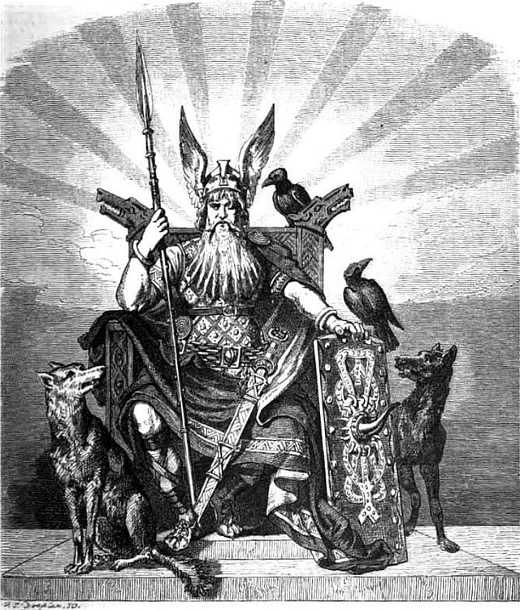
A Connection to the Gods
The most obvious starting point for the exploration of disability through Norse mythology is through Odin, the one eyed god. He willingly gave up his eye in trade for wisdom and knowledge, and there is no evidence of the god being mocked for his difference. Similarly, we may investigate the stories of Heimdallr, the watchman, who seemingly sacrificed an ear for a more powerful sense. The idea of giving up something valuable for the greater good introduces a common thread throughout Norse mythology and associated cultures: it is the importance of an individual to the functioning of a wider community which determines their value. Though Odin and Heimdallr might be impaired physically, their powers were in fact deepened through sacrifice. Despite this not being directly indicative of the treatment of disabled individuals, it implies that value is placed on necessary sacrifice, and that disability may even represent a connection to the gods within medieval Scandinavian cultures.
Physical Impairment and Community
The concept of sacrifice to serve one’s community is even more evident in the stories of Tyr, a god that gave up his hand such that the deadly wolf Fenrir might be bound. Such an impairment would not be foreign to the lives of medieval communities, and the lack of divine gain for its loss thus grounds Tyr’s sacrifice more than those of Odin or Heimdallr. Unlike the others, Tyr is mocked for his loss. Contextually, this may serve as a reminder that these views were not what we may consider as progressive.
These proposed attitudes can be complemented through reading Icelandic sagas, such as the family sagas collection (which focuses on ninth to eleventh century stories) and the Sturlunga saga (thirteenth century stories). These sagas are based on the lives of real Icelanders and are key sources in interrogating attitudes to disability in Norse culture. The family sagas detail many warriors with prosthetics, for example, who lead heroic lives. The Grettis saga and the Eyrbyggja sagas both detail warriors, Onundr and Thorir respectively, known by ‘wooden foot’ who lived rich and impressive lives with their limb loss. The fullness of their stories, showing capability in battle and in family life, demonstrates that impairment did not necessarily obstruct function in society and therefore should be detached from the connotations of ‘disability’ in our modern consideration of impairment.
Disability from Birth

Perhaps the most poorly explored example of physical impairment in the Norse myths is disability from birth. The god Hodr was blind from birth, and features in a single story in which he is fooled by Loki. Loki’s deception leads to Hodr killing his brother, Baldr, which inadvertently kick-starts Ragnarök (a series of events in which the gods perish).
Hodr’s blindness is an interesting one. We cannot know how he might have been viewed in society – only that he was disadvantaged enough that Loki could deceive him easily, but also that he was still able to be considered a god without dispute. There are debates over whether his blindness may represent something more metaphorical, linking to moral failings or shame. Whilst it is true that Norse storytelling did use disfigurement to represent characteristics, it is also important to consider that Hodr’s name means ‘warrior’ and that there are some polarising representations of him. Though in Prose Edda (the most commonly used source for Norse mythology) he is presented passively, the alternative source Gesta Danorum presents him more fully and fearsomely. Hence, though Hodr remains elusive and scarce from literature, he was clearly an important enough figure to not be considered a write-off in the society of the gods, despite his crucial mistakes.
In the Sturlunga saga, impairments often reflect negative characteristics and dysfunction within society. However, in many instances, adaptations are made by impaired individuals to allow them to remain functional even if this may not be in the typical way. An instance of this can be considered in the stories of a child, Thorgils Skarthi, born with a cleft lip. Though valued characteristics such as eloquence in communication are hindered, he attains a boldness in personality in order to garner respect. As is common in many other instances (see the sagas mentioned above), he gains a byname based on his difference, with skarthi meaning ‘harelip.’ This naming system is somewhat indicative of the potential of disability to interfere with society’s reputation surrounding a person. However, information is scarce enough regarding attitudes that we should be careful to disconnect this from the modern prejudices we might expect disabled individuals to encounter.
Thus, through Hodr and characters in Sturlunga saga, there is uncertainty in concluding medieval Norse attitudes towards disability from birth, but we notice a demonstrable potential for nuance within their culture.
Thor – How the Thunder God Enlightens us on Disability in Norse Cultures
A closing investigation to summarise the findings presented above is one featuring Thor. This may be surprising to the reader, as he is not known for physical impairment. However, there are many stories concerning this god which enlighten scholars further into the possible treatment of disability within old Norse societies.

We have already demonstrated that impairment was viewed with pragmatism based on how it affected an individual’s purpose within the community. In addition, the complexity in attitude towards disabled individuals has been highlighted, evidencing stigma but also the potential for respect. There are three stories within Thor’s mythology which encapsulate these ideas.
First of all, Thor’s chariot is pulled by two goats that may be regenerated to full health after being eaten, provided their bones remain intact. When Thor offers his goats to feed a peasant family, one of the children snaps a bone to eat the marrow and, as a result, this goat becomes lame. This angers Thor greatly as the goat becomes entirely useless to him. His subsequent abandonment of his goats is proof of the treatment of individuals based on their ability to perform tasks to serve others. Despite being prized possessions of the god, there is little evidence to support sentimentality in his treatment of them when they are no longer of use. This echoes ideas surrounding the concepts of impairment already expressed.
Another story featuring Thor extends this by impairing the god himself. In a fight with the giant Hrungnir, a whetstone is thrown at Thor’s head, splintering off to become all flint on Earth. One splinter remains lodged in Thor’s head permanently. This story is again proof of the value placed on sacrifice, and on how someone can benefit a community regardless of impairment. Thor remains seemingly unaltered by this injury and, in the process of obtaining it, grants a valuable resource to humans on Earth. Therefore, Thor yet again demonstrates the matter-of-fact view Norse culture takes to impairment based on their community needs.
Finally, one of the most important facets of Thor is perhaps the grandest representation of how perceived imperfection was disregarded due to functionality. The making of his infamous hammer, Mjolnir, is disrupted when Loki transforms into a fly to bite one of the craftsmen dwarves. As a result, the handle of Mjolnir is overly short, meaning it may only be wielded with a single hand. However, the weapon remains the most powerful and Thor is greatly pleased with it. As such, we may take people to be somewhat analogous to tools in the regard that their value within society is based on how they might be able to serve it.
Once again, I reiterate that this does not imply particularly progressive attitudes to disability, but presents us with a window into the lives of individuals living with impairment in medieval Norse communities. It is shown that the view towards impairment is somewhat simplistic, but not overtly negative nor positive. As with individuals that are not physically impaired, if a person’s purpose can be served, then their disability is not necessarily of consequence.
Final Remarks
As a closing note, I would like to draw upon a translated passage from the Hávamál (sayings of the high one) of the Poetic Edda to summarise well the attitude of medieval Scandinavian culture.
“The lame man rides a horse, the handless man drives a herd, the deaf man fights and succeeds, to be blind is better than to be burnt, a corpse is of no use to anyone.”
The importance of an individual seems not to be marred through physical impairment so long as they might still contribute to the function of society. As their gods are flawed and vulnerable like men, we can interpret many old Norse attitudes to disability through the characters they hold as important in their myths and sagas. Whilst conclusions drawn from literature are inevitably influenced by the societal context of sources to hand, such research as this may shift scholarly obsession away from leaders and kings and onto the lives of ordinary individuals that may have lived with disability.
Written by Serafina Coupe
Bibliography
Bragg, Lois. ‘Disfigurement, Disability, and Dis-Integration in Sturlunga Saga’, n.d.
‘Eight Histories of Disabled People in Ancient Egypt | British Museum’. Accessed 27 December 2024. https://www.britishmuseum.org/blog/eight-histories-disabled-people-ancient-egypt.
Guðbrandur Vigfússon. Eyrbyggja Saga. Leipzig: F.C.W. Vogel, 1864.
Hight, George Ainslie. The Saga of Grettir the Strong. Everyman’s Library ; No. 699. London: J.M. Dent, 1914.
Icelandic Saga Database. ‘Grettir’s Saga’. Accessed 27 December 2024. https://www.sagadb.org/grettis_saga.en2.
Larrington, Carolyne. The Poetic Edda. Oxford, UNITED KINGDOM: Oxford University Press, Incorporated, 2014. http://ebookcentral.proquest.com/lib/york-ebooks/detail.action?docID=5891404.
Lawson, Michael David. ‘Children of a One-Eyed God: Impairment in the Myth and Memory of Medieval Scandinavia’, n.d.
Norse Mythology for Smart People. ‘Hodr’. Accessed 27 December 2024. https://norse-mythology.org/hodr/.
‘Skáldskaparmal’. Accessed 27 December 2024. https://sacred-texts.com/neu/pre/pre05.htm.
‘The Icelandic Sagas | Travel Guide | Iceland Travel’. Accessed 27 December 2024. https://www.icelandtravel.is/exploring-the-icelandic-sagas/.
Vlasatý, Tomáš. ‘Amputation of the Lower Limbs of the Early Middle Ages and Their Prostheses – Projekt Forlǫg’, 3 March 2023. https://sagy.vikingove.cz/en/amputation-of-the-lower-limbs-of-the-early-middle-ages-and-their-prostheses/.
Images
Doepler, Emil. ‘Odin’. World History Encyclopedia. Accessed 27 December 2024. https://www.worldhistory.org/image/7588/odin/.
Sigurðsson, Jakob. ‘Baldr’s Death’. World History Encyclopedia. Accessed 27 December 2024. https://www.worldhistory.org/image/14604/baldrs-death/.
Unknown. ‘Prose Edda’. World History Encyclopedia. Accessed 27 December 2024. https://www.worldhistory.org/image/6412/prose-edda/.Winge, Mårten Eskil. ‘Thor Battling Giants’. World History Encyclopedia. Accessed 27 December 2024. https://www.worldhistory.org/image/5166/thor-battling-giants/.