Wentworth Woodhouse: Mea Gloria Fides
The origins of the house date to before 1066, with Rynold de Wynterwade (also known as Reginald of Wentworth) documented as living on the land in the Domesday Book. His descendant would go on to marry Emma of Woodhouse in the late thirteenth century, forming Wentworth Woodhouse. Twice the length of Buckingham Palace, at over 600 feet, this Grade 1 listed building is considered England’s longest country house. Though Wentworth Woodhouse did not start its journey to becoming the house it is today until the seventeenth century, this article will discuss the history of the site, focusing on the reasons for which it is considered a great survivor.

Building the Big House
In the better-documented history of Wentworth Woodhouse, the house had fifteen owners, who, until the World Wars, mostly experienced a lavish lifestyle – a party in 1731 is said to have had over 1,000 guests! In its time, Wentworth Woodhouse has undergone much expansion, including the works of notable architects like John Carr, Henry Flitcroft and Ralph Tunnicliffe.
The Earls of Strafford:
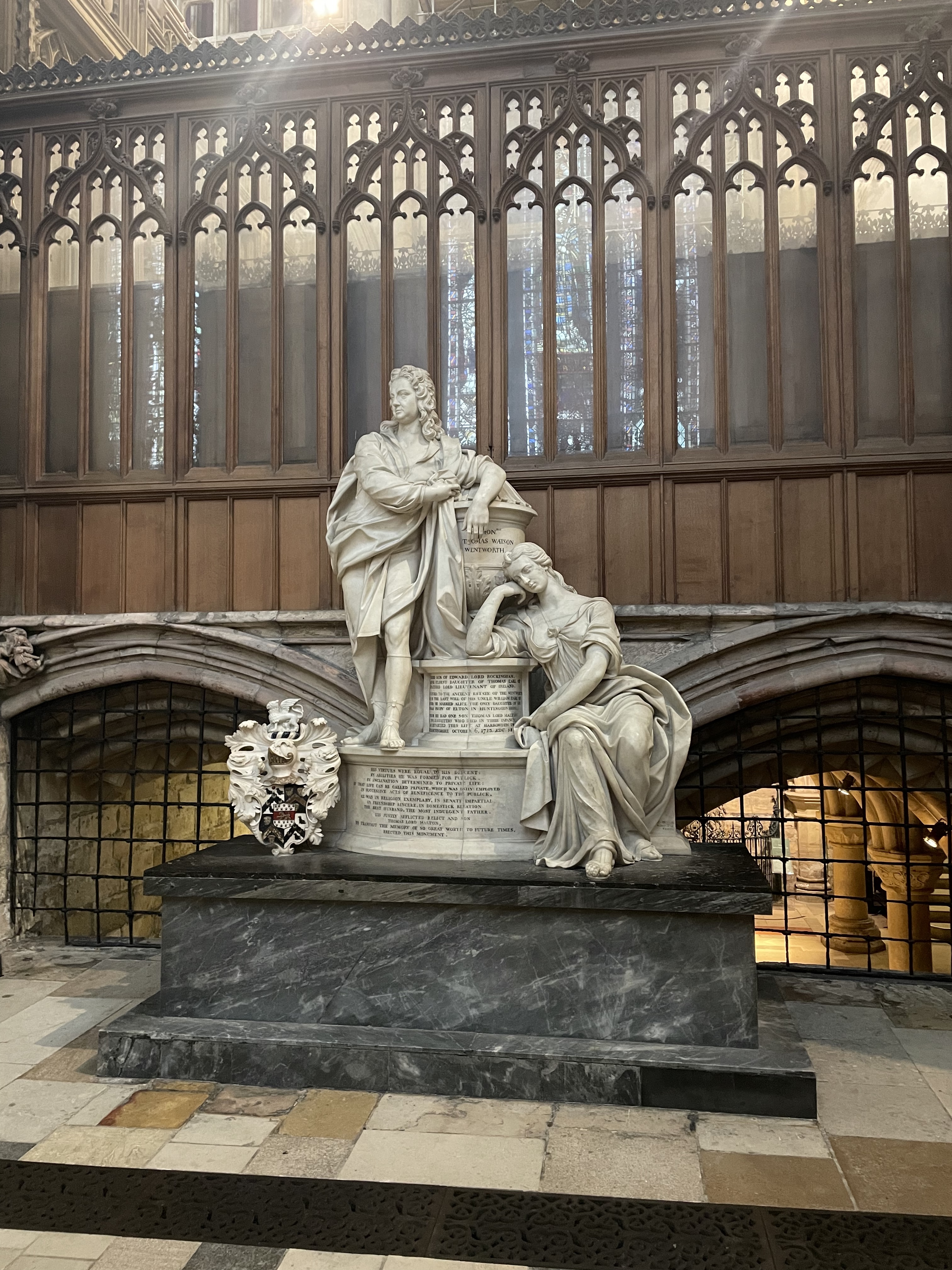
Painted by Anthony Van Dyck himself, there is no denying the importance of Thomas Wentworth, 1st Earl of Strafford (1593-1641). Playing a role in the run-up to the Civil War, he was a member of Parliament and loyal to King Charles I. However, his attempts to control Parliament meant that they saw the Earl as a threat. Thus, Parliament passed a bill of attainder against him, which ultimately led to his execution in London, despite the reluctance of King Charles I. In fear of vengeance from his father’s enemies, his son, William Wentworth, 2nd Earl of Strafford (1626-1695), left England. After taking an Oath of Abjuration, he was allowed to return to the country in 1652 and subsequently took over the estate, but did not regain the title Earl of Strafford until 1662. Upon his death, the earldom became extinct and, with no male heir, his nephew Thomas Watson (later, Watson-Wentworth due to a condition in his uncle’s will) inherited the house. In this period Wentworth Woodhouse was in Jacobean style, only some of which is still visible today, like in Chapel Court. The 2nd Earl of Strafford and Thomas Watson are both buried in York Minster.

The Marquesses of Rockingham:
Thomas Watson’s son, Thomas Watson-Wentworth, 1st Marquess of Rockingham (1693-1750), played a role in the Whig power of Yorkshire. It was under his ownership that Wentworth Woodhouse became the house it is today. From 1724-1734, the Baroque house was built onto the Jacobean house (West Front – once the front of the house, today it is visible from the gardens) but, before this house was finished, he started work on a second house: one that he would not see completed. Due to his political stance which favoured the Hanoverian succession, thus keeping England Protestant, the 1st Marquess decided to build the Palladium house to distance himself from the Catholic associations linked to Baroque and Jacobean styles. This house (East Front) had an enfilade design of rooms on the first floor and would have become the main entrance after the portico was built. Further exhibiting his wealth, the 1st Marquess also indulged in owning exotic species, something that would continue with succeeding owners. By 1737 the menagerie housed different animals and birds, with a total of 86 species being recorded during its existence. Additionally, the house was known to have grapes, bananas, and watermelons, with the 1st Marquess becoming known for his pineapples by the 1740s. The family’s fortune is known to have come from mining activity on the estate, as Catherine Bailey’s Black Diamonds explains. However, until around 1800 their fortune came mostly from agriculture and forestry. By 1750 small-scale mining had begun, and Elsecar Colliery was active. It would eventually become the centre of the family’s industrial empire around 100 years later when the mining industry boomed. Around this time, Charles Watson-Wentworth, 2nd Marquess of Rockingham (1730-1782), also led an important political career, favouring reconciliation with America and repealing the Stamp Act 1765. He built the stable block, including a courtyard and a riding school, and Keppel’s Column (for Admiral Augustus Keppel), standing 115 feet high. We also can thank the 2nd Marquess for the statues found in the Marble Saloon, brought back from Italy during his Grand Tour.
The Earl Fitzwilliams:
The Fitzwilliams were known for their genuine respect towards workers and villagers, and here, we will summarise the first three. Wentworth Woodhouse: The House, The Estate and The Family by Melvyn Jones, Joan Jones, and Stephen Cooper, explains that the annual household accounts from the eighteenth to the twentieth century included a section for ‘Bounties and Charities,’ which, at various times, contributed to not only medical charity in the area, but helped to subsidise ale at the local Rockingham Arms. The 2nd Marquess’ nephew, William Fitzwilliam, 4th Earl Fitzwilliam (1748-1833), built the Rockingham Mausoleum for his uncle in 1788 (though, in reality, it is a cenotaph) and the front of the Camellia house between 1812-1822 – the latter recently welcoming the public following the completion of a huge restoration project. Under the 4th Earl we see the family’s effort to help their community, constructing houses like Old Row for workers, after Elsecar Ironworks opened in 1795 (many of which are now Grade II listed buildings), and financing St Mary’s Church, Greasbrough. His son, Charles Wentworth-Fitzwilliam, 5th Earl Fitzwilliam (1786-1857), also aided the emigration of around six thousand people from their estates in Ireland to Canada during the Irish Famine, and financed a school which survives today, Wentworth Primary School. Furthermore, his son, William Wentworth-Fitzwilliam, 6th Earl Fitzwilliam (1815-1902), gave land to build St Thomas’ Church, Kilnhurst. His grandson would inherit the estate, but, under the circumstances of both World Wars, Wentworth Woodhouse would encounter a huge threat – demolition.

The Destruction of the Country House
The 1970s saw an increased awareness of heritage in England, highlighted by the Victoria & Albert Museum exhibition of 1974. The Town and Country Planning Act (1944) intended to help protect architecturally important residences from destruction, but was not enforced, as the fine against those who did not comply was usually less than development potential. With a rate of one house destroyed every five days by 1955 (1,200 houses were lost since 1900), many wanted to protect country houses to preserve national history, despite many being demolished or reconstructed since the fifteenth century. The development of these houses in the eighteenth and nineteenth centuries was replaced by destruction in the mid-twentieth century due to: houses becoming a tax burden; the damage from war leaving them unusable, and post-war society causing an exodus from domestic service, destroying the idea of privileged living. Wentworth Woodhouse was no exception.
After overcoming illegitimacy struggles, William Wentworth-Fitzwilliam, 7th Earl Fitzwilliam (1872-1943), experienced the grandeur, with King George V and Queen Mary staying at the house in July 1912. Yet, it was evident times were changing: the royal visit was, itself, part of a ‘Tour of the North’ attempting to dissuade industrial unrest. The royal presence at the house did not mean to say that these socio-economic complaints were with the Fitzwilliams. The fact that their former Irish properties Coollattin House and Carnew Castle still stand, despite most British country houses being destroyed in the Irish Wars of Independence, shows the respect that existed between them and those on their estates. During World War I, the stables housed the West Riding Royal Horse Artillery, and the 7th Earl formed a battery following Haldane’s Territorial Force 1908. Wentworth’s men found themselves in the Middle East and the Western Front, and a memorial to eighteen who died can be found in Wentworth Parish Church. Later, in World War II, the house was used as a base for the Military Intelligence Corps, and soldiers went through motorcycle and weapon training, learnt about the British Army administration and drill, and partook in weeks of exercise and intensive field security. The family retreated to the West side of the house, putting many possessions into the cellars as the Army took over the main house, stables, riding school, and even built Nissen hut accommodation.
“Open-cast coal mining is the cruellest form of devastation that can befall the landscape short of actual war.”
– “WENTWORTH WOODHOUSE DEVASTATION.” (Dec 15, 1944). Country Life (Archive : 1901 – 2005), 1028.
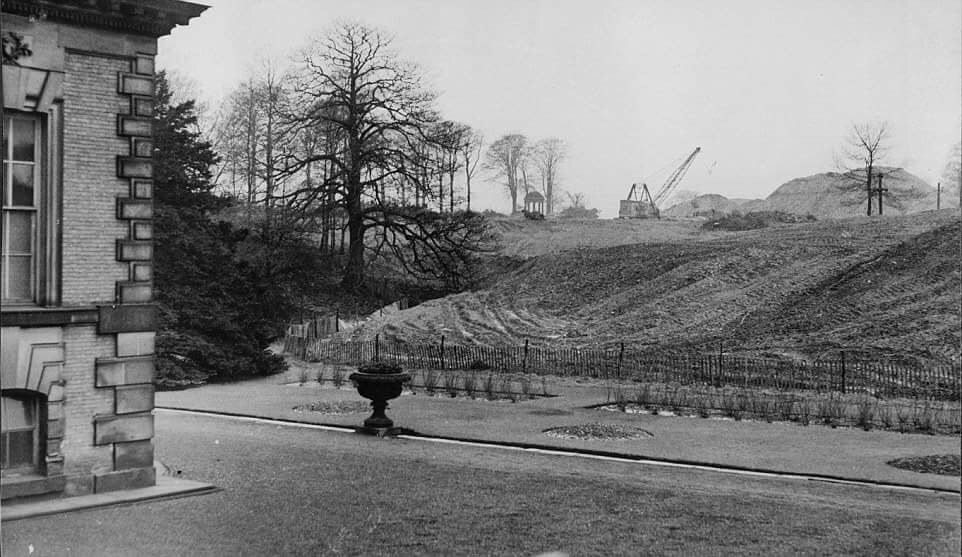
For Wentworth Woodhouse, the fight continued after the War, with coal being nationalised in 1947 (although they did receive some amount of compensation). When the government returned the house its condition was already diminishing and, with rising taxes, it became harder to afford the upkeep. Needing to produce a vast amount of coal due to a balance of payments crisis and the exceptionally cold winter of 1946-1947, Manny Shinwell, Minister of Fuel and Power, forced open-cast mining upon the Estate, despite local protest. Peter Wentworth-Fitzwilliam, 8th Earl Fitzwilliam (1910-1948), tried to prevent this, offering the house to the National Trust or suggesting drift-mining as an alternative, but to no avail: by 1946, mining had started in the fields around Wentworth and right up to the West Front – coal dust is still visible on the stonework. The controversy was that Shinwell declared the coal to be high-quality, but the Department of Fuel and Technology at Sheffield University deemed this incorrect.

Death duties caused further misfortune. In a short period of time, the earldom became extinct: the 8th Earl died in a plane crash with Kathleen Kennedy in 1948, the 9th Earl, Eric Spencer Wentworth-Fitzwilliam, died in 1952, and the 10th Earl, Thomas (Tom) Wentworth-Fitzwilliam, died in 1979. Around the time of the 8th Earl’s death, the Ministry of Health wanted to turn the house into housing for homeless families, but he declined. His aunt, Lady Mabel, however, convinced him to offer the house to West Riding County Council on a 50-year full-repairing lease. From 1949, the East Front and Stable block became the Lady Mabel College of Physical Education, training female P.E. teachers before, in 1979, it merged with Sheffield City Polytechnic (Sheffield Hallam) until 1986.
The schools left in 1988 and, in the following year, the family removed the house from the wider estate, putting it on the open market where it was bought by Wensley Haydon-Baillie. However, an unfortunate business deal left him bankrupt and unable to keep the house.
Saving Wentworth Woodhouse
Starting a programme of restoration and guided tours to the public, the Newbold family purchased Wentworth Woodhouse for £1.5 million in 1999. The family owned the house until 2017, when it was bought by the Wentworth Woodhouse Preservation Trust (WWPT) for £7 million, after a five-year campaign.
The ever-increasing restoration bill estimates well over £200 million today, much more than the £100 million originally predicted. Much work has already begun, including roof repairs costing over £7 million, the restoration of the Camellia house, and the Stable’s current Regeneration project – only naming a few of the large-scale improvements. The outbreak of COVID-19 caused further set-backs for the trust, disrupting visitor income and putting a pause on the planned events programme. However, thanks to generous donations from the National Lottery Heritage Fund, WWPT was given a lifeline – helping to pay wages and improve digital plans, like an online fundraising shop. WWPT also used this time to kick-start their garden plans. Today, over 50-acres is open for the public to enjoy.

Wentworth Woodhouse has even made its way onto our screens, featuring in Darkest Hour, Billionaire Boy, Gentleman Jack, and Bodies, just to name a few. The work of staff and volunteers has enabled this place to become a key part of the community once more, including educational opportunities for young people and exhibitions that focus on local history. WWPT equally gives people a chance to do their bit to support Wentworth Woodhouse, whether that’s using the café, exploring the house and gardens, or visiting the shop. It is largely unknown that WWPT is a charity, and their fundraising schemes allow the public to get involved in raising money for the house by donating, becoming a Big House Hero, or with the Forge a Link Campaign. WWPT aims to offer opportunities and experiences that appeal to a range of different demographics. Furthermore, the events team strives to increase public awareness of the house, whether that be car shows, festivals like WE Wonder, or another magical Christmas season. The income from events generates a vital revenue stream that directly finances the restorations of the house. There is still so much planned for the future of Wentworth Woodhouse, with more restorations and new experiences like tours, exhibitions, and even the RHS Flower Show in the summer of 2025.

The East Front portico includes the Marquess of Rockingham family motto, Mea Gloria Fides (faith is my glory). With the continuing effort and belief of staff, volunteers, and the public in returning the house to its former glory, the motto still holds prominence today. Given the chance, it is worth a visit to see the beauty for yourself.
By Finlay Ratcliffe
Bibliography:
Adams, Ruth. “The V&A, The Destruction of the Country House and the Creation of ‘English Heritage’”. Museum & Society 11, no.1 (2015):1-18. https://journals.le.ac.uk/index.php/mas/article/view/219.
British Film Institute. “Outcrop at Wentworth 1943”. BFI Player. Accessed Nov 2024. https://player.bfi.org.uk/free/film/watch-outcrop-at-wentworth-1943-1943-online.
Country Life. “DIFFICULTIES AT WENTWORTH WOODHOUSE.” Country Life (Archive: 1901 – 2005). Jun 7, 1946, 1030. https://www.proquest.com/magazines/difficulties-at-wentworth-woodhouse/docview/1521498048/se-2.
Country Life. “WENTWORTH WOODHOUSE DEVASTATION.” Country Life (Archive: 1901 – 2005). Dec 15, 1944, 1028. https://www.proquest.com/magazines/wentworth-woodhouse-devastation/docview/1521473166/se-2.
Daniels, Joshua. “Wentworth Woodhouse – A New History (Documentary).” YouTube video, 18:51. Posted by “JoshDanielsHist.” Oct 21, 2021. Accessed Nov 2024. https://www.youtube.com/watch?v=85sTUUyvznE.
Daniels, Joshua and Steven Jones. “The History of Wentworth Woodhouse”. Historic Houses. Jul 10, 2020. Accessed Nov 2024. https://www.historichouses.org/the-history-of-wentworth-woodhouse/.
Darlington, John. “Dramatic House, Dramatic History: Wentworth Woodhouse Purchased for the Nation”. World Monuments Fund. March 29, 2017. Accessed Nov 2024. https://www.wmf.org/blog/dramatic-house-dramatic-history-wentworth-woodhouse-purchased-nation.
Delcito. “Wentworth Woodhouse”. House and Heritage. May 22, 2018. Accessed Nov 2024. https://houseandheritage.org/2018/05/22/wentworth-woodhouse/.
Doughty, Eleanor. “‘In 2018 the bill to restore the house was £200m – there’s no point putting a figure on it now’.” Telegraph. Mar 24, 2024. Accessed Jan 28, 2025. Wentworth Woodhouse – so big guests were given confetti to find their rooms.
Elizabth, Dianne. “Wentworth Family History.” Rootsweb. Sept 3, 2013. Accessed Nov 2024. https://freepages.rootsweb.com/~eaglesnest/genealogy/Histories/wentworth.html#:~:text=As%20far%20as%20I%20have,the%20Norman%20conquest%20in%201066.
Emery, Phil. “Wentworth Woodhouse. A Political Building.” Phil Emery Visits…. Dec 13, 2023. Accessed Nov 2024. https://philemeryvisits.com/wentworth-woodhouse-01/.
Explore Heritage. “Inside the UK’s largest Country House: Wentworth Woodhouse History and Photos.” Explore Heritage. Sep 23, 2024. Accessed Nov 2024. https://www.xploreheritage.com/post/inside-the-uk-s-biggest-country-house-wentworth-woodhouse-history-and-photos#:~:text=Wentworth%20Woodhouse’s%20history%20goes%20back,avert%20the%20impending%20civil%20war.
Historic Houses. “Wentworth Woodhouse”. Historic Houses. Accessed Nov 2024. https://www.historichouses.org/house/wentworth-woodhouse/history/.
Jones, Melvyn, Joan Jones and Stephen Cooper. Wentworth Woodhouse: The House, The Estate and The Family. Yorkshire – Philadelphia: Pen & Sword Books Ltd, 2021, 2022, 2023.
Landon, J. W. B. “CORRESPONDENCE: THREAT TO WENTWORTH WOODHOUSE.” Country Life (Archive: 1901 – 2005). Oct 5, 1945, 604. https://www.proquest.com/magazines/correspondence-threat-wentworth-woodhouse/docview/1521473321/se-2.
Pearce, Sarah. “Shock and shutdown, then silver linings – How Wentworth Woodhouse survived the pandemic.” Heritage Trust Network. Jan 4, 2021. Accessed Nov 2024. https://heritagetrustnetwork.org.uk/shock-and-shutdown-then-silver-linings-how-wentworth-woodhouse-survived-the-pandemic/.
Sheffielder. “Wentworth Woodhouse.” Sheffielder. Mar 21, 2020. Accesses Nov 2024. Wentworth Woodhouse.
Turner, Christopher. “How the Versailles of Yorkshire Was Saved from Ruin.” Apollo Magazine. April 28, 2022. Accessed Nov 2024. https://www.apollo-magazine.com/wentworth-woodhouse-versailles-yorkshire/.
Wentworth Woodhouse Preservation Trust. “A New Life: The Masterplan 2018. Wentworth Woodhouse.” Wentworth Woodhouse. Accessed Nov 2024. WWH-Masterplan-vol1_Compressed.pdf.
Wentworth Woodhouse Preservation Trust. “Our Story: Wentworth Tales”. Wentworth Woodhouse. Accessed Nov 2024. Our Story – Wentworth Woodhouse; “The Great Survivor”. Wentworth Woodhouse. Accessed Nov 2024. https://wentworthwoodhouse.org.uk/discovery/the-great-survivor/; “Wentworth Woodhouse Changing Lives”. Wentworth Woodhouse. Accessed Nov 2024. https://wentworthwoodhouse.org.uk/news/wentworth-woodhouse-changing-lives/#:~:text=The%20Trust%20bought%20the%20house,spend%20went%20to%20local%20companies.
Wikipedia. “Destruction of Country Houses in 20th-Century Britain”. Wikipedia. Sept 13, 2024. Accessed Nov 2024. https://en.wikipedia.org/wiki/Destruction_of_country_houses_in_20th-century_Britain#:~:text=By%20the%20end%20of%20the,tantamount%20to%20a%20social%20revolution; “Wensley Haydon-Baillie”. Wikipedia. Sept 27, 2024. Accessed Nov 2024. https://en.wikipedia.org/wiki/Wensley_Haydon-Baillie; “Thomas Wentworth, 1st Earl Strafford”. Wikipedia. Jan 20, 2025. Accessed Jan 28, 2025. https://en.wikipedia.org/wiki/Thomas_Wentworth,_1st_Earl_of_Strafford; “William Wentworth, 2nd Earl of Strafford”. Wikipedia. Oct 27, 2024. Accessed Jan 28, 2025. https://en.wikipedia.org/wiki/William_Wentworth,_2nd_Earl_of_Strafford; “Thomas Watson-Wentworth”. Wikipedia. Oct 10, 2023. Accessed Jan 28, 2025. https://en.wikipedia.org/wiki/Thomas_Watson-Wentworth.
Images:
Ratcliffe, F. Photos of 2nd Earl of Strafford and Thomas Watson at York Minster. York, 2024.
Wentworth Woodhouse Preservation Trust. “A Tale as Old as Time: Christmas Event.” Photograph. Wentworth Woodhouse Preservation Trust, Rotherham, 2023.
Wentworth Woodhouse Preservation Trust. “Bombay Baja Brass Band at WE Wonder & Basant Kite Festival.” Photograph. Wentworth Woodhouse Preservation Trust, Rotherham, 2024.
Wentworth Woodhouse Preservation Trust. “East Front.” Photograph. Wentworth Woodhouse Preservation Trust, Rotherham.
Wentworth Woodhouse Preservation Trust. “East Front Portico in Winter.” Photograph. Wentworth Woodhouse Preservation Trust, Rotherham.
Wentworth Woodhouse Preservation Trust. “Lady Mabel College.” Photograph. Wentworth Woodhouse Preservation Trust, Rotherham.
Wentworth Woodhouse Preservation Trust. “The Camellia House.” Photograph. Wentworth Woodhouse Preservation Trust, Rotherham.
Wentworth Woodhouse Preservation Trust. “The West Front After Open-Cast Mining.” Photograph. Wentworth Woodhouse Preservation Trust, Rotherham.