Race on the Rails: How Resistance to Racial Discrimination at London Euston Strengthened the UK’s Anti-Discrimination Laws
When we in the United Kingdom think of racial discrimination, especially in employment, our minds inevitably wander overseas. The United States will likely come up first – the brave struggle of African Americans demanding equality in the face of violence and repression, and the charismatic leadership of Martin Luther King Jr. Or we may think of Apartheid South Africa, the fight against poverty and segregation and, again, the noteworthy leadership of the likes of Nelson Mandela. What we do not tend to think about are two things: segregation and discrimination in Britain itself, and the contributions not of “Great Men” (and women), but of ordinary people who sought a better life for both themselves and their communities.
The modern British public can perhaps be excused for this – unlike the Southern US or South Africa, the UK never had a legislative system of blanket discrimination. Furthermore, when so much of contemporary and popular history focuses on great men, it’s very easy to forget the ordinary people who equally contributed to the fight for justice and equality. This article, however, intends to highlight the struggle of a name that few have heard of: Asquith Xavier, a Black West Indian railwayman who, after being denied a position at London Euston Station due to his race, fought a battle of publicity against the decision. His fortitude and strength in this struggle ultimately proved successful, helping to expose the extent of racial discrimination in the UK and likely contributing to the passage of the 1968 Race Relations Act. Despite his efforts, Xavier’s struggle went unrecognised for decades, but growing academic and public attention towards the hidden racial histories of Britain has ensured his efforts were not forgotten.

By the 1960s, large numbers of Afro-Caribbean (or “West Indian”) immigrants were settling in the UK, with employment emerging as a major obstacle facing this community. Racial prejudice was predictably rife in post-war Britain, with many regarding Black migrants as lazy, unintelligent, dirty and unwilling to integrate into British culture. In 1967, a report by the Political and Economic Planning think-tank laid it bare: nearly half (45%) of West Indians, around 1 million in total, reported personal experiences of racial discrimination in employment, with the actual number likely being far higher, as many immigrants were refused work without being told the real reason. Those in work found their allocated tasks were often far below their abilities and former experience, with West Indians in particular being deemed as only suitable for unskilled manual labour. Most resistant to non-white immigrants were public-facing jobs, such as shop assistants, waiters and train guards, with the expectation that white customers would be driven away by the prospect of being served by Black workers. Whilst the Trade Union Congress (TUC) officially opposed discrimination, many union officials and members shared the same prejudices as their employers, and regarded immigrants as being unwilling to participate in union activity. All of this was to some extent protected by law, as by 1969 no court case had ever stated that racial discrimination was at odds with public policy. In short, much of the country was covered by a de facto “colour bar,” designating all too many immigrants as second-class citizens.
Despite the numerous problems faced by immigrants in employment, many white Britons were (or at least claimed to be) opposed to racial discrimination, including various Westminster politicians. In 1965, Harold Wilson’s Labour government passed the Race Relations Act, which banned racial discrimination in “public places,” such as restaurants and shops. The Act, however, was quickly criticised for not going far enough: it was a conservative measure passed with Conservative support, designed to de-politicise the issue of race, and as such left many areas uncovered, including employment. The Act also established the Race Relations Board, to which minorities could report instances of discrimination, but its power to act was weak, designed to facilitate conciliation rather than to enforce integration. Numerous groups, including liberal politicians, academics, and immigrants themselves, knew the law would have to be expanded.
It was in this context that Asquith Xavier, a Dominican immigrant, arrived in Southampton with his family in 1958. The very next day, he was recruited by British Railways, the former nationalised operator of Great Britain’s rail services, as a carriage cleaner and porter at London Marylebone, one of the capital’s many termini. Employed as a policeman before he left Dominica, Xavier was well-regarded by his colleagues and peers; he had a “natural authority” and was described by fellow railwayman, Tony Donaghey, as a “semi-father figure,” who helped many fellow West Indian immigrants to settle in London. In less than a year, he had been promoted from porter to guard, a post he held at Marylebone for another seven years.
British Railways (renamed British Rail in 1965) was a complex organisation that was subdivided into numerous geographical regions, the management of which were often fiercely independent of the national executive. As such, different stations and lines had different practices regarding employment, including that of immigrants. Although Asquith Xavier was able to earn a promotion at Marylebone, other London termini were more than unwelcoming to non-whites. Strikes at King’s Cross in 1952 and Liverpool Street eight years later in 1960 took place to protest against the promotion of West Indians, whilst in 1961 it came to light that Paddington’s 1,000-strong staff lacked any non-white employees. As such, despite the Railways Executive denying that racial discrimination was practised across their network, reality was undoubtedly otherwise.

During the 1960s, British Rail (BR) undertook a sweeping programme of reform and modernisation, part of which included the closure of thousands of miles of track and stations. Amongst the most prominent to be cut down as part of these reforms was the Great Central Railway out of Marylebone: the resulting decline in traffic prompting many of its staff to reluctantly relocate. Amongst these was Asquith Xavier, who applied to become a guard at London Euston. What should have been a simple transfer, however, was denied when the Local Department Committee at the station rejected Xavier’s application on the explicit grounds of his race. The Euston staff regarded West Indians as only suitable to be porters, cleaners and other lower-ranking staff; they could not take jobs that faced the public. Furthermore, guards required knowledge of how to manage many different types of traction, such as steam, diesel and AC and DC electric. Racist stereotypes of West Indians as lazy and incapable ensured that Xavier was considered unsuitable for such a complex task.
It goes without saying that Xavier’s case was not unique, but the explicit racism of his rejection compelled him to protest the decision. However, he was not to fight alone. The aforementioned Tony Donaghey, who was given Xavier’s place at Euston, turned it down in solidarity with his fellow railwayman (the Irish Donaghey was no stranger to prejudice). Furthermore, the NUR (National Union of Railwaymen) branch secretary, Jimmy Prendergast, took the matter to the union’s national board, and after six weeks of no response, instead reported it to the press. Newspapers responded critically to the discrimination, and soon Xavier’s fight was known nationwide. He received the support of two notable organisations, the West Indian Standing Conference (WISC), and the Campaign Against Racial Discrimination (CARD). WISC was an umbrella organisation formed in the aftermath of the 1958 Notting Hill Riots to promote the interests of, and provide leadership for, the growing Afro-Caribbean community in the UK. Meanwhile, CARD, formed after a visit by Martin Luther King, Jr. to London in December 1964, lobbied for further race relations legislation. In particular, it encouraged non-white citizens to report instances of discrimination to the Race Relations Board that could not be resolved under the 1965 Act, in order to demonstrate its shortcomings. Xavier’s rejection gave them a high-profile example of this, and the organisations’ efforts helped his case to gain further publicity. Questions were duly raised in Parliament, with Labour MPs William Hamling and Lena Jeger writing to the Transport Minister, Barbara Castle, in Xavier’s defence. Castle addressed Parliament on July 15, 1966, affirming the government’s opposition to racial discrimination whilst making an explicit reference to Xavier’s case. On the same day, the national BR board overturned his rejection, finally promoting him to the position of guard.
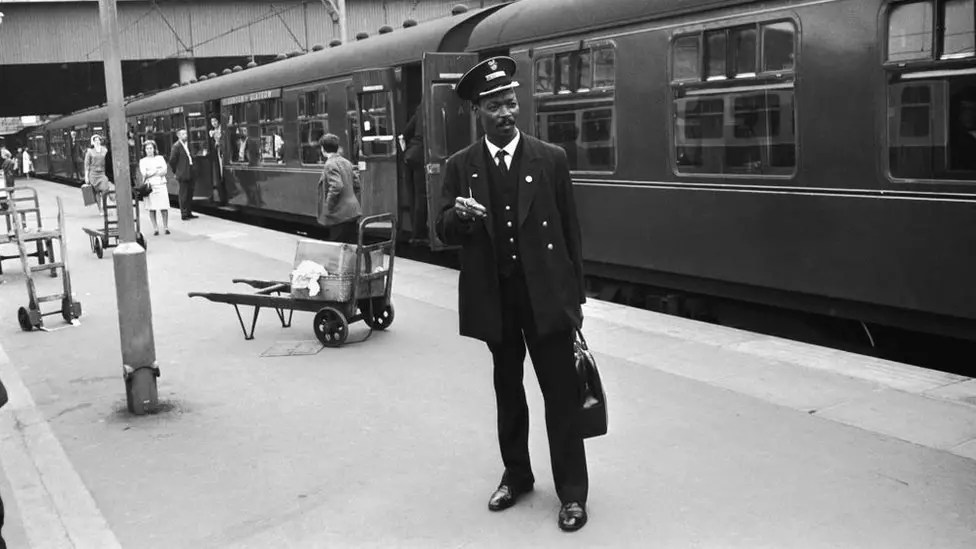
For Xavier himself, the whole ordeal was not without its consequences, causing him considerable stress that resulted in him being admitted to hospital. After taking up his post in August, arriving fifty minutes early on his first day, he received numerous death threats and required police protection to get to and from work. Nevertheless, such problems did not prevent him from handling the discrimination he faced with dignity, strength and tenacity.Within a year of Xavier starting, Donaghey had described how the workplace at Euston had changed significantly for the better. Sadly, ill health forced him to step down from his position in the early 1970s, and he passed away in 1980, aged just 59.
As stated previously, Xavier’s case was one amongst thousands in the UK of West Indian and other immigrants facing discrimination in the workplace. What made him stand out, however, was the Euston committee’s explicit racism, and the ensuing nationwide publicity that the affair garnered. But there were so many more figures like Xavier, who refused to accept the discrimination they faced and fought for equal treatment in employment, yet today go unrecognised in the public mind. Many of these individuals organised, helping to form organisations such as the WISC and CARD which campaigned heavily for stronger legislation to protect non-white immigrants. The fruits of their labour would come to pass with the 1968 Race Relations Act, a much stronger law that banned racial discrimination in both housing and employment.
As mentioned previously, it is likely that Xavier’s fight spurred on the passage of the 1968 Act to some extent. It would be an overstatement to suggest that he was the sole catalyst for the law’s implementation: Roy Jenkins, Home Secretary from 1965 to 1968, believed strongly in a multicultural and multiracial society, and had always intended to expand and strengthen the 1965 Act. However, he did not want to act until both the public and politicians were convinced that racial discrimination was a serious problem to be addressed by Parliament. The aforementioned 1967 PEP report, commissioned by Jenkins, unveiled just how entrenched colour bars were across the country, and was successful in convincing many of the benefits of further legislation. Similarly, given the attention Xavier’s case gained in Parliament and the press, it is feasible that his struggle was another factor in Jenkins’ mission to win over both Westminster and the public. It is worth noting that Bob Hepple, one of the foremost experts on race relations of the 1960s, referenced Xavier’s case in his writings around the time of the Act’s passage, highlighting the “considerable publicity” that the dispute generated: a further indication that his struggle was fresh in the minds of many across the country. In short, it is certainly conceivable that Xavier’s fight did contribute to the 1968 Act’s passage.

After his passing, Asquith Xavier was almost forgotten by history, going unrecognised in discussions of both race and the railways for decades. Only in the 2010s, when greater attention began to be paid to systemic racism, did acknowledgement of his struggle emerge. A plaque was unveiled at London Euston station by his family in 2016, with a second later being dedicated at his home station of Chatham in 2020, and a train was named in his honour in 2023. Any remembrance of him should be accompanied by a recognition of the countless other immigrants who also faced and fought hostility and prejudice in the country they called home. And whilst his influence on racial legislation is debatable, taking the view that Xavier’s fight did contribute to the 1968 Race Relations Act is a fitting tribute to the man who was loved and respected both in his community, and amongst his fellow railwaymen, so strongly, and for so long.
Written by Oscar Hilder
Bibliography:
Primary sources:
Avanti West Coast. “Asquith Xavier Train 9.” Photograph. Avanti West Coast, 2023. Accessed October 18th, 2024. https://newsdesk.avantiwestcoast.co.uk/resources/asquith-xavier-train-9.
Chatham Historic Dockyard. “Local Windush Hero – Asquith Xavier.” Photograph. Chatham Historic Dockyard, 2021. Accessed October 19th, 2024. https://thedockyard.co.uk/news/local-windrush-hero-asquith-xavier/.
Hansard. “Coloured Workers.” Hansard Parliament UK. July 15th, 1966. Accessed October 14th, 2024. https://hansard.parliament.uk/Commons/1966-07-15/debates/b65aca94-436b-4d17-90a6-3a40aaa9716c/ColouredWorkers.
Kid, C. “Euston Station – 2.” Photograph. Wikimedia Commons, 1974. Accessed October 18th, 2024. https://commons.wikimedia.org/wiki/File:Euston_Station_-_2_-_geograph.org.uk_-_3129056.jpg.

Our Labour Staff. “‘Colour Bar’ Alleged.” Financial Times, July 11, 1966, 9. Financial Times Historical Archive. Accessed October 7th, 2024. https://link.gale.com/apps/doc/HS2301364953/FTHA?u=uniyork&sid=bookmark-FTHA&xid=70a19930.
Our Labour Staff. “Colour Bar Ends at Euston Station.” Financial Times, July 16, 1966, 9. Financial Times Historical Archive. Accessed October 7th, 2024. https://link.gale.com/apps/doc/HS2302270769/FTHA?u=uniyork&sid=bookmark-FTHA&xid=83c0a491.
Secondary sources:
Avanti West Coast. “Pendolino named Asquith Xavier in honour of train guard who fought the colour bar.” Avanti West Coast newsdesk. October 2nd, 2023. Accessed October 18th, 2024. https://newsdesk.avantiwestcoast.co.uk/news/pendolino-named-asquith-xavier-in-honour-of-train-guard-who-fought-the-colour-bar.
BBC. “Asquith Xavier: Plaque honours train guard who fought Whites-only policy.” BBC News. September 24th, 2020. Accessed October 17th, 2024. https://www.bbc.co.uk/news/uk-england-kent-54272188.
BBC. “Black History Month: Train named after guard Asquith Xavier.” Photograph. BBC Newsround, 2023. Accessed October 18th, 2024. https://www.bbc.co.uk/newsround/66985586.
Bleich, Erik. Race Politics in Britain and France. Cambridge: Cambridge University Press, 2003.
Daniel, William. Racial Discrimination in England. Harmondsworth: Penguin Books Ltd. 1968.
Davis, John. “Xavier, Asquith Camile (1920-1980).” Oxford Dictionary of National Biography. October 13th, 2022. Accessed October 6th, 2024. https://www.oxforddnb.com/view/10.1093/ref:odnb/9780198614128.001.0001/odnb-9780198614128-e-90000380766#odnb-9780198614128-e-90000380766-div1-3.
Hepple, Bob. Race, Jobs and the Law in Britain. London, Allen Lane: The Penguin Press, 1968.
Hepple, Bob. “The British Race Relations Acts, 1965 and 1968.” The University of Toronto Law Journal Volume 19, issue no. 2 (1969): pp. 248-257.
Kushnick, Louis. “Chapter 9 – British Anti-Discrimination Legislation.” In The Prevention of Racial Discrimination in Britain, edited by Simon Abbott, 233-268. London: Oxford University Press, 1971.
McLean, Andrew. “Blowing the Whistle on the British Railways Colour Bar.” Railway Museum. October 7th, 2020. Accessed October 7th, 2024. https://blog.railwaymuseum.org.uk/blowing-the-whistle-on-the-british-railways-colour-bar/.
Page, Chris. “Resistance to change.” Railfuture. October 10th, 2016. Accessed October 17th, 2024. https://www.railfuture.org.uk/article1722-Resistance-to-change.
Ramdin, Ron. “West Indian Standing Conference.” In The Oxford Companion to Black British History, edited by Dabydeen, David, Gilmore, John, and Jones, Cecily. Oxford University Press, 2007. https://www.oxfordreference.com/view/10.1093/acref/9780192804396.001.0001/acref-9780192804396-e-432.
Saggar, Shamit. Race and Politics in Britain. Hemel Hemstead: Harvester Wheatsheaf, 1992.
Saunders, Sarah. “The Bristol Bus Boycott.” Photograph. Anti-Racist Cumbria, 2021. Accessed October 18th, 2024. https://antiracistcumbria.org/the-bristol-bus-boycott/.
Shukra, Kalbir. The Changing Pattern of Black Politics in Britain. London, etc.: Pluto P., 1998.
Smith, David. The Facts of Racial Disadvantage. London: PEP, 1976.
Wikipedia contributors, “Great man theory,” Wikipedia, The Free Encyclopedia. Accessed November 5th, 2024. https://en.wikipedia.org/wiki/Great_man_theory.
Wolmar, Christian. British Rail – the Making and Breaking of Our Trains. Milton Keynes: Penguin Books, 2023.
Xavier-Chihota, Camealia, “Omitted from History: Asquith Xavier.” Black History Month. October 1st, 2020. Accessed October 7th, 2024. https://www.blackhistorymonth.org.uk/article/section/bhm-firsts/omitted-from-history-asquith-xavier/.