Josephine Baker: Fame, France and Fighting for a Cause
Although Black history should be integrated and highlighted in mainstream history all year round, that is often not the case. Black History Month is the prime opportunity to start acknowledging the contribution that Black people have made to society throughout history, recognising their efforts and giving them the appreciation they deserve. It is important that we recognise all forms of Black history, including male and female.
This article will aim to shine a light on the works of Josephine Baker, entertainer, spy and civil rights advocate. She faced discrimination due to the colour of her skin and her sex; the fight for her recognition continued until as late as 2021, although this was not without controversy amongst certain groups.
Her Journey to France

Born in St. Louis, Missouri, in 1906, Josephine Baker (née Freda Josephine McDonald) grew up in an impoverished household, having to sacrifice most of her studies to work, so that she could support her family. During the 1917 East St. Louis Riot, she was made homeless and became aware of the severe racism present in the area where she lived. By 1919, aged 13, she had taken an opportunity to join the Dixie Steppers, a travelling theatre troupe who performed around America. Aged 15, she found herself in New York City where she performed in Vaudeville shows. This was a popular form of entertainment from the end of the nineteenth century to the start of the twentieth century, which included a variety of acts including magicians, dancers and singers, acrobats and trained animals. It is said that, during her time here, she was picked up by a talent scout who persuaded her to perform in Paris.
From 1925 she performed her Danse Sauvage with the troupe La Revue Nègre in the theatres of Paris. There had been a surge of interest in Black music and dance after jazz music had made its way to France, and Josephine became a great success, gaining the nickname ‘Black Venus.’ People loved her unique style of performance, something they had never seen before – most famously her Banana Dance included dancing semi-nude in a skirt of artificial bananas. It was in France, and then Europe, where her rise to fame started, leading her to become the first African American female to star in a feature film, La Sirène des Tropiques in 1927, and then later the first to star in a major film, Zouzou in 1934. Josephine Baker was one of the first African Americans entertainers to achieve international acclaim in movies and on stage, especially internationally. This break in Paris allowed her to overcome racial barriers and helped her to prevail in terms of gender stereotypes, as well.
Her Role in the Second World War
Having gained her French citizenship in 1937, by the outbreak of the Second World War in 1939, Josephine Baker felt more French than she did American. Josephine helped in the war effort in a variety of ways, and her actions were key in helping the French Resistance.
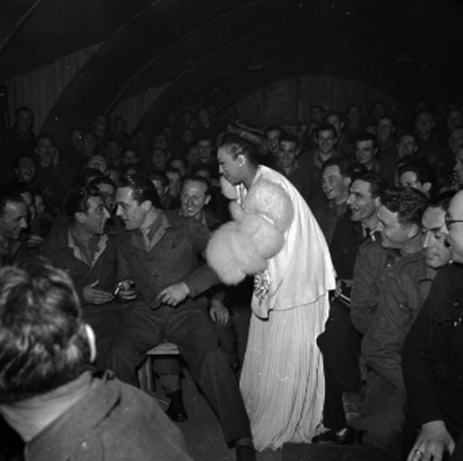
Having already made her mark by performing on stage and in movies, she was a well-known face in the entertainment scene and loved by many. This popularity meant that she was sent to perform for French and American soldiers on the front, as well as other nationalities. At the start of the war, Josephine Baker joined the Resistance and ultimately became a spy for the French war effort. Using her role as a travelling performer to enable more liberty in movement, she helped pass key messages that she had heard while performing in front of the enemy to French and British intelligence – specifically by using invisible ink on her music sheets. Josephine also helped to smuggle and hide weapons, refugees and Resistance fighters in her home, Les Milandes, a château in the Dordogne region of France. Today it is a national historical monument owned by Angelique de Saint- Exupéry. She spent years refurbishing the home and hunting down objects from auctions to honour Josephine’s life, with each room representing a different era she lived.
Further overcoming gender stereotypes, Josephine had a pilot’s licence, which she earned around 1936. This helped her greatly in her endeavours, allowing her to transport refugees and supplies for the Red Cross. In the early 1940s, Josephine joined the Women’s Auxiliary in the air arm of the Free French Forces (Forces Françaises Libres, FFL), and became a lieutenant. As part of General Charles De Gaulle’s Free French Army, she was sent to Morocco to set up a liaison and transmission centre for the Resistance in Casablanca. Here, she continued her work in obtaining visas for Jewish refugees and conversing with diplomats and Resistance members. It is said that she travelled to Morocco with her Great Dane, monkeys and mice, along with 28 pieces of luggage so that it would be more inconspicuous and raise less suspicions to any witnesses, due to her character.
Josephine Baker became the first American woman to receive French military honours due to all the risks she took and her contributions to the French war effort. Following Germany’s surrender, Josephine was awarded numerous honours by General De Gaulle including the Croix de Guerre (War Cross), which was an award that signifies bravery, the Rosette de la Resistance for courage of the French people against the enemy, and the Légion d’honneur in 1961, France’s highest civilian award and decoration for military service showing great service to the country.

Josephine Baker became the sixth woman and Black person, but the first Black woman and pilot, to be “laid to rest” in the Pantheon of Paris, forty-six years after she died. Josephine died April 12th, 1975, from a stroke, four days after the opening of her retrospective revue to mark fifty years of her entertainment career. The celebrations for her induction into the Pantheon took place on November 30th, 2021, and, although it is not the day she died, represents the day she chose to take French nationality through marriage. Today the Pantheon is a mausoleum for many prominent French citizens, but unlike other figures laid to rest here Josephine was actually buried in Monaco in 1975. Thus Josephine’s coffin in the Pantheon only includes soils from four places that were prominent in her lifetime: St. Louis, where she was born; Paris, because of her entertainment success there; her Chateau in the Dordogne region; and Monaco, her final resting place. It was the ‘Dare Josephine’ campaign, launched in 2019, that led to her gaining recognition in the Pantheon by President Macron after over 37,000 people signed the petition.
However, this celebration was not welcomed well by everyone, specifically Black French activists, who have been fighting against the institutional racism that is still present in the country. Many believe that this recognition creates a narrative of good and bad amongst the Black community, with local Black people being the ‘bad’. This idea that local Black people are seen as ‘bad’ appears from the fact that they feel as if their concerns go unheard, while the state pays homage to someone who died many years ago. There is also an argument that this tribute to Josephine Baker manifests itself as a form of negrophilia, meaning a form of Black cultural appropriation whereby Josephine has been exploited for cultural attributes, potentially with links to sexualisation or objectification. Thus, it could be perceived that the state chose Josephine to be rewarded in this way, as a popular Black performer and heroine in France, to be a scapegoat. By entering Josephine into the Pantheon, the state attempts to show that there is no racism in France, however this does not reflect the current political climate in France and fails to recognise that most of her activism was done in America.
Fighting for Civil Rights
Not only did she fight in the Second World War, Josephine also spent much of her energy on the Civil Rights Movement in America. Although she did challenge racism in America before the Second World War, it was not until the end of it that she joined the Civil Rights Movement properly. After being treated closely to an equal to her white counterparts in Europe, she noticed the difference when she returned to America where she suffered direct racial abuse from the American press. She still received some racism in France, but it was more subtle and less brutal, according to Josephine.
During her career she had to use service entrances instead of the main one at an event or would find her hotel reservation had been cancelled. Yet, this didn’t stop her from using her fame and status to challenge segregation and discrimination in America, specifically in terms of her audience. Josephine would not perform in clubs where segregation occurred, thus causing owners to allow integration as it was more important to them to host such a well-known entertainer. An example of her work to desegregate audiences can be seen during her 1952 stay in Las Vegas – which would stay segregated until the Moulin Rouge Agreement of 1960. Although her actions were not permanent, desegregation was achieved for the time she was there, and she ensured a self-reserved table would be filled with Black people at every show. She instructed them to notify her if they received any troubles with entry to the show, and she would often bring them in herself as a result. Yet, once inside, the discrimination continued, with the bar staff refusing to serve them. In response, Josephine refused to perform until they had their drinks; evidently, Josephine recognised that her presence was important to club owners and used it to her advantage.
Josephine flew to America from France specifically to take part in the 1963 March on Washington, where she was the only female speaker and spoke just before Martin Luther King. She also gave speeches at Historically Black Colleges and Universities (HBCUs) in the South and created her Rainbow Tribe; this included her 12 children that she had adopted from various ethnic backgrounds to emphasise that it was possible for people of different races and cultures to live together peacefully. In 1951, her activism was honoured by the National Association for the Advancement of Colored People (NAACP) by declaring May 20th as Josephine Baker Day.
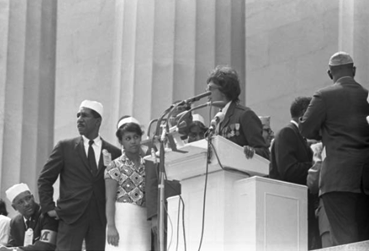
“I have walked into the palaces of kings and queens and into the houses of presidents. And much more. But I could not walk into a hotel in America and get a cup of coffee, and that made me mad.”
Josephine Baker, 28th August 1963.
By Finlay Ratcliffe
Bibliography:
Images
Gaston Paris/Roger Viollet via Getty Images.
Keystone-France/Gamma-Keystone via Getty Images.
Jack Esten/Picture Post/Hulton Archive via Getty Images.
Antoine Gyori/Corbis via Getty Images.
Estate of Roosevelt H. Carter via Getty Images.
Sources
Al Jazeera. “Josephine Baker: The Life of an Artist and Activist.” Al Jazeera. June 3, 2017. Accessed September 25, 2024. Josephine Baker: The life of an artist and activist | Racism | Al Jazeera.
Beardsley, Eleanor. “Josephine Baker is the first Black woman to be inducted into France’s Pantheon.” NPR. November 30, 2021. Accessed September 25, 2024. Josephine Baker is inducted into the French Pantheon : NPR.
Blackpast. “(1963) Josephine Baker, “Speech at the March on Washington”.” Black Past. November 3, 2011. Accessed October 2, 2024. https://www.blackpast.org/african-american-history/speeches-african-american-history/1963-josephine-baker-speech-march-washington/.
Chrisafis, Angelique. “Josephine Baker, music hall star and civil rights activist, enters Panthéon.” The Guardian. November 30, 2021. Accessed September 25, 2024. Josephine Baker, music hall star and civil rights activist, enters Panthéon | France | The Guardian.
Consulat Général De France A New York. “Black History Month – Josephine Baker, a woman of two loves: her country and Paris.” Consulat général de France à New York. February 29, 2024. Accessed September 25, 2024. Black History Month – Josephine Baker, a woman of two loves: her country (…) – Consulat général de France à New York (consulfrance.org).
Coquillon, Naomi. « Amazing People, Amazing Lives: Josephine Baker.” Library of Congress. March 17, 2021. Accessed September 25, 2024. Amazing People, Amazing Lives: Josephine Baker | Minerva’s Kaleidoscope (loc.gov).
Dugdale, Bernard. “Josephine Baker Moved to the Panthéon.” The Chain Gang. May 12, 2022. Accessed September 25, 2024. Josephine Baker Moved to the Panthéon – The Chain Gang.
Guenfoud, Ibtissem. “Josephine Baker receives one of France’s highest honors 46 years after her death.” ABC News. August 23, 2021. Accessed September 25, 2024. Josephine Baker receives one of France’s highest honors 46 years after her death – ABC News (go.com).
Hutchinson, George. Harlem Renaissance. Britannica. August 19, 2024. Accessed September 24, 2024. https://www.britannica.com/event/Harlem-Renaissance-American-literature-and-art/Poetry.
IWOAW. “Josephine Baker, the first pilot at the Pantheon.” Institute for Women of Aviation Worldwide. December 1, 2021. Accessed October 1, 2024. Josephine Baker, the first pilot at the Pantheon | iWOAW.
ISTD. “Saluting Our Sister: Josephine Baker.” Imperial Society of Teachers of Dancing. October 9, 2023. Accessed September 24, 2024. Saluting Our Sisters: Josephine Baker – Imperial Society of Teachers of Dancing (istd.org).
Klein, Christopher. “Josephine Baker’s Daring Double Life as a World War II Spy.” History. March 15, 2021. Accessed October 1, 2024. Josephine Baker’s Daring Double Life as a World War II Spy | HISTORY.
LOC. “Joséphine Baker.” Library of Congress. N.d. Accessed September 24, 2024. Joséphine Baker – French Women & Feminists in History: A Resource Guide – Research Guides at Library of Congress (loc.gov).
NMAAHC. “Josephine Baker.” National Museum of African American History & Culture. N.d. Accessed September 24, 2024. Josephine Baker | National Museum of African American History and Culture (si.edu).
Norwood, Arlisha R. “Josephine Baker.” National Women’s History Museum. 2017. Accessed September 24, 2024. Josephine Baker | National Women’s History Museum (womenshistory.org).
Scarbrough, Meg. “Josephine Baker: Singer, Dancer, Spy … and Pilot.” Flying Mag. November 30, 2021. Accessed October 1, 2024. Josephine Baker: Singer, Dancer, Spy … and Pilot – FLYING Magazine.
Spindel, Barbara. “Singer, dancer, pilot, spy: Josephine Baker’s wartime career.” The Christian Science Monitor. August 9, 2022. Accessed October 1, 2024. Josephine Baker’s fame provided a cover for wartime spying activities – CSMonitor.com.
The Editors of Encyclopaedia Britannica. “Vaudeville.” Britannica. September 23, 2024. Accessed October 1, 2024. Vaudeville | Definition, History, & Facts | Britannica.
White, Claytee. “How Josephine Baker Challenged Las Vegas Racism.” AAIHS. May 3, 2022. Accessed September 25, 2024. https://www.aaihs.org/how-josephine-baker-challenged-las-vegas-racism/.
Younge, Gary. “Giving Josephine Baker a Hero’s Grave Won’t Bury the Truth…” The Nation. November 29, 2021. Accessed September 25, 2024. Giving Josephine Baker a Hero’s Grave Won’t Bury the Truth… | The Nation.