“Upon Which Order The Child Was Brought To Him Which He Refused To Take”: The Fathers and Grandparents of Illegitimate Children in Early Modern England
Introduction
Illegitimate children were a recognisable feature of early modern society. Most early modern parishes would have counted a handful of children and adults of illegitimate birth. Richard Gough’s 1701 The History of Myddle identified at least sixteen ‘bastards’ in the small rural parish and suspected at least four more. Despite this prevalence, such individuals were marked out from their legitimate peers by virtue of their birth, and lacked the legal right to inherit familial property, name, or poor law settlement. The mothers of illegitimate children formed their only legal family. These mothers bore the brunt of responsibility for providing for their illegitimate children, often facing poverty and dependence on poor relief. Despite this, most illegitimate children were aware of the identities of their apparent fathers; the majority of ‘bastard births’ that appeared before the authorities name a reputed father, as the punishment for bearing an illegitimate child tended to be more severe if the mother refused to name a father.
Furthermore, while the mother formed the only legal family, both paternal and wider maternal families could find themselves co-opted into the child’s upbringing. This could be at the insistence of the authorities or out of necessity and family loyalty. Involvement could range from providing purely financial support to providing shelter and playing an active role in raising their child or grandchild. The roles that fathers and grandparents might have played varied significantly, but often boiled down to the destitution faced by mothers and the risk of the child becoming a parish burden.
Fathers of the Aristocracy and Gentry
The difference in circumstance between those of aristocratic and genteel parentage and those of more ordinary parentage was stark. Some aristocratic ‘bastards’ found themselves in far more fortunate circumstances than their less genteel counterparts. A 1698 will by Sir Richard Mauleverer leaves a bequest to Thomas Newsham, the “naturall son” of his late brother, providing Thomas with forty pounds per annum at half yearly intervals until his reaching of the age of eighteen, with payments of two hundred pounds per annum made afterwards. Similarly, after his death in 1630, Lord Emmanual Scroop’s three illegitimate daughters by Martha Janes, a servant, went on to marry into the upper classes. This good fortune did not apply to all illegitimates of genteel and aristocratic ancestry, as some putative fathers shirked their responsibility, placing their offspring in situations similar to the illegitimate children of husbandmen, craftsmen and labourers.
More affluent illegitimate fathers might also attempt to bribe or persuade other men to marry the mothers of their illegitimate children and assume paternity. One such example is seen in the 1619 case of Bridget Tolly, who alleged that her illegitimate child was fathered by Edward Broade while she was employed as a servant at his home, Dunkeley Park. Tolly claimed that Broade “not only refuseth to accept and receive the says child, but also refuseth to geve to the says child or to the petitioner any penny at all.” Bridget Tolly also states in her petition that Edward Broade sought to marry her off to “one Heath his mylner,” and have him named as the child’s reputed father.
Child Maintenance
In the vast majority of cases, the involvement of an illegitimate child’s father was limited to the payment of child maintenance, something which was often compelled by the authorities in order to prevent the child becoming a financial burden on the parish. This desire to find individuals to provide for the child could result in the misidentification of fathers. An entry made in the London sessions records and dated January 1707 vacates an order in which John Pitchford had been adjudged to be the father of Mary, an illegitimate child. Another entry from July of the same year cleared Thomas Barnes, a barber, of fathering “the female bastard of Thomasin Hankinson, Widow.” Thomasin’s husband had been found “alive and often seen in London,” and her child was therefore legitimate. That same month, John Williams was cleared of fathering the “female bastard of Elizabeth Washborn” of Holborn. As in the case of Thomas Barnes, Elizabeth’s husband had been found to be alive. Among reputed fathers, there existed an overrepresentation of higher social levels. In bastardy proceedings in Essex during the 1650s, the lowest social levels were underrepresented, with husbandmen, yeomen, artisans and tradesmen making up the majority of reputed fathers. Similarly, a July 1709 entry in the records of the London sessions lists the professions of reputed fathers as a gentleman, a lacemaker, a surgeon and a merchant. These misidentifications and the trend towards naming wealthier individuals may simply have been due to a need to find men able to make maintenance payments.

The making of child maintenance payments might also fall to an illegitimate child’s paternal grandfather in the event of a father’s absence or inability to pay. A 1619 case saw the father of William Cowles, who had fathered an illegitimate child, ordered by the authorities to pay sixpence weekly towards the child, until he presented his son. This case reflects a wider trend in which paternal grandfathers of illegitimate children might face a financial penalty or order to pay child maintenance in the event of an absconding father.
Fathers might be ordered to assume the role of primary caregiver to their illegitimate child. This was rare, given that a man who admitted to the paternity of an illegitimate child had no legal rights to custody over that child. A 1619 case in the parish of Tettenhall, Staffordshire, describes how Thomas Hardwicke was ordered to keep an illegitimate child reputed to be his, “upon which order the child was brought him which he refused to take.” This expectation for Hardwicke to raise his child may have resulted from his residence in a different parish, and be an attempt by the parish of Tettenhall to evade responsibility for this child. A similar case is seen in a 1639 petition by inhabitants of Dudley, Worcestershire, which calls for an order to ensure that John Jevon of Sedgley, Staffordshire, maintained and kept his illegitimate child, having “most unnaturally left the said childe in the parish of Duddley.” The petitioners describe the situation with “the mother beeinge fled and the reputed father refusing to keepe the same childe.” As with Hardwicke, Jevon’s residence in a different parish may indicate a desire to discharge themselves of the child. Regardless, both cases see fathers being ordered to keep and raise their illegitimate offspring, and exhibit an involvement beyond maintenance payments.
Maternal Grandparents
The involvement of maternal grandparents in sheltering, raising and advocating for their illegitimate grandchildren was far more common. This support was hugely needed, as the vast majority of mothers remained unmarried and often struggled to gain employment, particularly those working as live-in servants, owing to their damaged reputation. In addition, parishes and justices were reluctant to provide parish pensions to women living alone, as female-headed households were felt to be disorderly. Therefore, many illegitimate children relied heavily upon the assistance and aid of their maternal grandparents. In the 1619 case of William Cowles and his father, the petition for financial relief was brought by Margery Darby, a widow and the maternal grandmother to the child who describes herself as “constrayned to keep” her daughter and the daughter’s illegitimate child.
In the same year, a petition by Thomas Hillman of Bromsgrove, Worcestershire, was brought against John Wilkes, the reputed father of Hillman’s daughter Alice’s bastard child, which alleged that Wilkes had failed to pay the court ordered maintenance. A 1657 petition by William Bladen of Ilam, Staffordshire, describes the imprisonment of his daughter Siciley for bearing an illegitimate child, leaving Bladen responsible for her four children, including her illegitimate child, and greatly impoverished by it.
All three cases depict instances of illegitimate children relying on a maternal grandparent for shelter and financial provision. Both Thomas Hillman and Margery Darby also advocate on behalf of their daughters and illegitimate grandchildren to the authorities, possibly due to the children’s mothers being relatively young.

Conclusion
The involvement of putative fathers and paternal grandfathers was primarily financial, and sought to prevent the child becoming a burden on the parish authorities. Nonetheless, a few fathers exhibited involvement in their children’s lives beyond this, although this tended to be at the authorities’ insistence. Maternal grandparents could also play a vital role in the upbringing of their illegitimate grandchildren, providing for them materially and advocating for them before the authorities. Maternal family tended to exhibit a far more practical involvement, compared to paternal relations whose financial involvement was often more distant. This may have resulted from the mother’s position as the child’s only legal relative and primary caregiver. Despite lacking the legal rights of their legitimate counterparts and finding themselves among the most disadvantaged of society, many illegitimate children still benefited from the support and input of family beyond that of their mother.
Written by Olivia Boyle
Bibliography
Images
Consistory Court, St Nicholas’ Chapel, King’s Lynn (image credit: Hannan-Briggs, 2017).
The Denunciation; or, A Woman Swearing a Child to a Grace Citizen by Hogarth (image credit: National Gallery of Ireland, 1729).
Peasant Family at a Well by Le Maître aux Béguins (image credit: The Art Institute of Chicago, 1650/60).
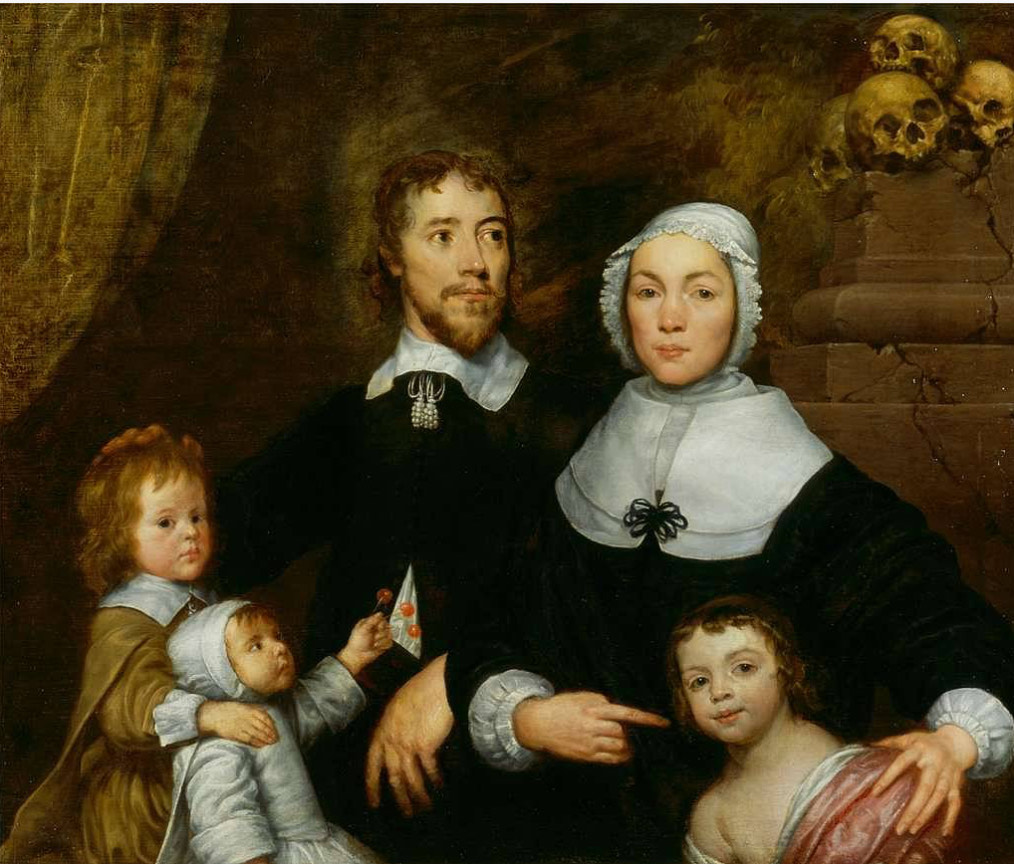
Portrait of a 17th Century Family by William Dobson (image credit: Yale Centre for British Art, 1600-1699).
Primary Sources
British History Online, Bridget Tolly Alias Reignoles, A Poor Distressed Woman, 1619.
British History Online, The Churchwardens, Overseers of The Poor and Other Inhabitants of Duddeley, Co. Worcs., 1639.
British History Online, Elizabeth Evans, of Tenbury Parish, 1677.
British History Online, The Inhabitants of Tettenhall, 1619.
British History Online, Margery Darby, Widow, 1619.
British History Online, Sessions Book 645-January 1707, 1707.
British History Online, Sessions Book 650-July 1707, 1707.
British History Online, William Greene, 1619.
British History Online, Thomas Hillman of Bromsgrove, 1619.
Civil War Petitions, Petition of William Bladen of Illam, Staffordshire, 14 July 1657.
The University of Nottingham: Manuscripts and Special Collections, Ga 9384: Probate Copy (Canterbury) of The Will (Dated 15 October 1688) of Sir Richard Mauleverer, Appointing Dame Barbara His Wife He Executrix, Making the Principal Bequests to Her, and a Bequest to Thomas Newsham Also Mauleverer, Natural Son of Sir Thomas Mauleverer, His Late Brother, 1688.
Secondary Sources
Capp, B., ‘The Missing Generation: Grandparents and Agency in Early Modern England’, History 108/379-380 (2023), pp. 41-63.
Crawford, P., Parents of Poor Children in England, 1580-1800 (Oxford, 2010).
Cressy, D., Birth, Marriage and Death, Ritual, Religion and the Life Cycle in Tudor and Stuart England (Oxford,1997).
Gibson, K., Illegitimacy, Family, and Stigma in England, 1660-1834 (Oxford, 2022).
Walker, G., ‘Child-Killing and Emotion in Early Modern England and Wales’, in K. Barclay, K. Reynolds, & C. Rawnsley (eds.) Death, Emotion and Childhood in Premodern Europe (Basingstoke, 2016), pp.151-172.
Wilson, A., Ritual and Conflict: the Social Relations of Childbirth in Early Modern England (Farnham, 2013).Worthen, H., & B. McDonagh, A. Capern, ‘Gender, Property and Succession in the Early Modern English Aristocracy: the Case of Martha Janes and Her Illegitimate Children’, Women’s History Review 30/1 (2021), pp.49-68.
Interesting that men from wealthier professions tend to be listed more than working laborers. The article claims that this may have been done simply to list a man who would be able to financially provide for the child. This seems possible but I wonder how often women would feel comfortable doing this knowing it’d be sure to invite hostility from said wealthy men. It crossed my mind that there could be a few other reasons for listed men being disproportional by profession. Namely, disputes with poorer men may have been settled out of court, records of the cases weren’t maintained because the relevant individuals were considered unimportant, or men who were financially better off may have felt more emboldened to engage in extramarital affairs.
I don’t have much information on if any of these answers would be correct beyond general intuition though, just food for thought. Very good article. I learned a lot. Especially interesting how maternal grandparents would often support the child.
LikeLike
Pingback: A quick history of England’s bastard children–and their mothers | Notes from the U.K.