To an Icy Grave: The Lost Franklin Expedition, its Legacy, and the Horror of an Arctic Death
Introduction
Few things can instil such a primal fear in humans as extreme cold, one of our species’ greatest foes, as monstrous as the things lurking in the dark, brutal and unforgiving. To satisfy the Halloween spirit, I chose a tragedy that sounds more fantasy than history; an overconfident expedition into a harsh and unknown wilderness, faced with deadly cold, endless nights and an unpredictable, lethal landscape. Two veteran ships of the world’s largest empire would be lost, with all hands, in a tragedy that is in equal parts a mystery.
By 1845, almost all the corners of the map had been filled in, few coastlines remaining unmapped, few sea routes unexploited by the empires of the day. But the Poles remained a tantalising mystery, the space exploration of their day, and the Northwest Passage in particular was one of the major goals of those who set out to brave the cold. This theoretical northern route connecting the Atlantic and Pacific was a prize that the British empire had long coveted for the quick trade route it would provide to Asia.
John Franklin was a man of considerable polar experience, yet he was no man’s first choice to lead the expedition. His polar service began with a failed 1818 voyage, and an overland expedition in 1823, when he almost succumbed to starvation, losing ten men to hunger and cold. This misadventure made him known as the man who ate his own boots.
Notable and popular polar explorers like James Clark Ross turned down command of the voyage, while the experienced Francis Crozier, who had mapped parts of the South Pole, was turned down because of his Irish heritage:
“They had named nothing after him. There is, on this October winter’s dark-day evening in 1847, no arctic or antarctic continent, island, bay, inlet, range of mountains, ice shelf, volcano, or fucking floeberg which bears the name of Francis Rawdon Moira Crozier.”
Into the Unknown
So it was that two ships, veterans of polar exploration, crewed by 129 men in the discovery service, embarked on a voyage that would lead only to disappearance and death.
When approaching this story from a historical perspective, the confidence with which the sailors approached their task is striking; the Erebus and the Terror were uniquely designed to tackle the ice, equipped with steam engines, heating and reinforced hulls, as well as enough canned food to last three years or more. Yet therein lay the problem.
For two months, there was smooth sailing from Britain to Greenland, the expedition being sighted in Baffin Bay during late July 1845, but no other Europeans would ever lay eyes on them.
Believed to have been buried while the crews wintered on Beechey Island (1845-1846), the bodies already showed evidence of an insidious and unseen threat: lead-poisoning. It is believed that this medical threat resulted due to the soldering of cans containing preserved meats, a relatively new process to which the Admiralty went to the lowest bidder in order to save money. Chemical evidence of high lead concentrations in the crew’s bones and hair led researchers to suggest the presence of lead-poisoning. Scurvy may have also run rampant, as despite taking 930 gallons of lemon juice, these stores likely lost much of their anti-scurvey properties over the years that the expedition spent trapped in the Arctic.
The summer of 1846 saw the Erebus and Terror freed and able to travel down Peel Sound, wintering again off King William Island, believed at the time to have been connected to the mainland. Only this time there was to be no reprieve from the cold, as the two ships became remained trapped in ice until 1848, by which time John Franklin had died (11th June 1847), and the crew forced to rely more on their tainted canned provisions, likely growing sicker and more disheartened as the ice kept them restrained:

“It’s true that the pack ice squeezing ever more tightly against Terror is always rumbling, moaning, cracking, snapping, roaring, or screaming.”
By April 1848, the crew had abandoned their ships, led by Franklin’s seconds, Captain Crozier and Commander Fitzjames, having lost 9 officers and 15 men in the last winter, a journey as horrific as the diseases that plagued them. Scurvy would have led to bleeding gums, loose teeth, skin discolouration and shortness of breath, while lead poisoning would have given the men joint and muscle pain, fatigue, headaches and cramps.
Unsurprisingly, not a single man survived the journey; even choosing to cover the smooth ice along the coast rather than the rough land, the crew would have made barely 2 miles a day. Of perhaps 100 who survived long enough to flee the ships, only 30 appear to have made it as far as the mouth of Great Fish River, watched by Inuits as they fell down and died on the ice, unable to escape its draining hold.
A Futile Search
For years, while the Expedition shivered inside ice-locked ships, spoons digging into lead poisoned food, Franklin’s wife, Lady Jane, had been undertaking a publicity campaign to put pressure on the Admiralty. By means of sponsorship and her social influence, even bringing a young Charles Dickens on board, the courageous widow directly sponsored seven searches from 1850-1857 and instigated many more. But for all the effort finally brought to bear, little would be discovered about the fate of those 129 men, just a few artefacts and human remains such as those found on Beachy island. Such remains allowed for the application of forensic evidence, which gave insight into the horror of the crew’s situation. Scurvy, starvation, lead poisoning, and cannibalism betrayed by cut marks on bones are horrors unimaginable to many of us today, and would have been a terrible torture for these men to endure.
Skeletal evidence suggested that the crew had turned to cannibalism in the end, but Lady Jane Franklin vehemently opposed this idea, accusing the explorer John Rae of slander.
As I myself am safe from Lady Jane’s ire, I have no qualms about siding with John Rae on this; for years, those Inuits interviewed by searchers had described the crew’s suffering, their fall into cannibalism. Yet for decades they were ignored, their insightful stories rejected on the basis of arrogant outrage that Englishmen could never act in such a way.
Inuit oral accounts, the discovery of the Beechey Island bodies, and insight from other explorers all helped build a faint picture of the Expedition’s fate, but it may be the Victory Point Note that reveals the most. Dated 1848 and found 11 years later on King William Island, Captain Crozier of the Terror and Commander Fitzjames of the Erebus record how they spent their first winter on Beechey Island, but became trapped in the ice off King William Island from 1846-1848. Franklin’s death is mentioned, as well as the crew abandoning their ships in a 248-mile march to the Canadian mainland, and it seems that was as far as they ever got.
As time went on, the searches would dwindle, then end entirely, the mystery remaining barely scratched, Lady Jane’s devotion to her husband unsatisfied when she died in 1875. 2014 marked the discovery of Erebus in Queen Maud Gulf, 2016 that of Terror in Terror Bay, followed by numerous dives returning artifacts to the surface for the first time since the 19th century.
The Story
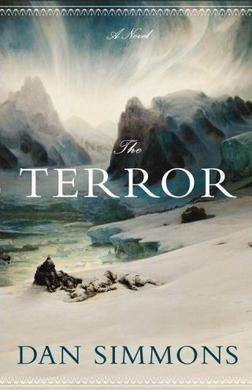
I, like many others, was introduced to this historical tale by Dan Simmons’ novel The Terror (2007), by far the most successful work inspired by this historical mystery, both a novel nominated for the BFA award, and a ten-part series adapted by AMC in 2018.
Through disjointed and multi-perspective storytelling, Simmons constructs a narrative of the voyage through entrapment in the ice to their desperate struggle to reach civilisation again. From their first winter trapped in the Arctic ice, the voyage’s fate becomes dire; lead poisoning emerges among the crew, while a creature inspired by Inuit mythology begins terrorising the crew, cutting the head from the exhibition through the brutal killing of John Franklin. But from the very first page of the novel, it is the cold that traps and threatens the crew the most:
“To go out on the frozen sea in the dark now with that … thing … waiting in the jumble of pressure ridges and tall sastrugi was certain death.”
A fatal encounter with an Inuit shaman brings the wrath of this mythological, shapeshifting creature down on the crew. The Tunbaq causes considerable bloodshed and devastation, from its killing of Franklin to tearing through a carnival held on the ice and cutting down the few men who finally make it to Back river. Preyed on both by this terrible force of nature and the more literal hostility of the ice that they are trapped in, the crew withers, struck by loss after loss especially after their march to the mainland begins:
“In a few days, there would be no real day at all, only arctic night. Round-the-clock night. One hundred days of night.”
Now I perhaps had the misfortune of reading this novel after already watching its screen adaptation and familiarising myself with the historical story. But, despite knowing that none of these sympathetic and extremely human characters could survive, Simmons’ still writes with enough skill to have you desperately rooting for the explorers.
As seems common in literature surrounding the lost expedition, Simmons’ chose to imbue the ending to his story with a dash of hope, having one of the crew survive and go on to live a life with the Inuit. But even here, this apparent triumph is tainted by the ice; the Tunbaq was confined to the ice of King William Island, trapped and forced to struggle. Now this lone survivor too is trapped on the ice, forced to remain in the very Arctic environment that took friends, home and purpose from him.
A Morbid Legacy
At the time of writing, there was much that remained a mystery about the Franklin Expedition, chiefly the fate of the Erebus and the Terror; for years it was assumed that the ships had been destroyed by the immense power of shifting ice floes. Yet it was not so, and a monumental discovery was made in the 2010s when the ships were discovered, having moved from what scholars believed to have been their resting place and separated by shifting ice sheets.
Another accusation could be levelled against Simmon’s characterisation of Cornelius Hickey, a secondary antagonist who appears to fit the vicious stereotype of gay characters as manipulative villains. The only clearly gay character in the novel, Hickey is murderous, mutinous and manipulative, taking advantage of a mentally challenged crew-mate and encouraging those who follow him to turn to cannibalism before developing a god complex. While aspects of this are toned down in the television adaptation, it still feels a tad reductive that in an environment that might foster gay relationships, the only one shown in Simmons’ novel is such a harmful stereotype. More-so, we should perhaps question the fairness that this explorer, who likely suffered the terrible fate of scurvy and lead poisoning, trapped in ice and left to die cold and hungry, thousands of miles from the world he knew, should have his legacy reduced to that of a “short, rat-faced” villain.
I think, if there is one thing to take from the tragedy of the Franklin Expedition, it is to remember man’s place in the world. For all our technological advancement and the distance we have placed between ourselves and the dangers of a world that alone would see us perish, nature often still has its way with us. I admit it is hard to put myself in the place of those lost sailors, and perhaps that is why Dan Simmons’ work has been so successful, reminding us of the oldest and most dangerous horrors our species has had to face. Cold, disease, isolation, such things are as primordial to humans as any Lovecraftian old one, more threatening as a faceless, creeping killer than a Jack the Ripper or folkloric Spring-heeled Jack. Oftentimes, the greatest horror one can experience is the very world on which we find ourselves; uncaring and uncooperative with any attempts to tame or conquer it.
Written by Jack Rooney
Bibliography
AMC, “The Terror.” Photograph. 2014.
Baugh, L. Sue. “Franklin expedition.” Encyclopedia Britannica, August 26, 2023. https://www.britannica.com/event/Franklin-expedition.
Bayliss, Richard, “Sir John Franklin’s last arctic expedition: a medical disaster.” Journal of the Royal Society of Medicine 3, 95 (2002): 151-153.
Li. “The Terror.” Mediaversity, June 22, 2019.
NYC. “Adults and Lead poisoning.” NYC Health. Accessed Nov 15, 23, https://www.nyc.gov/site/doh/health/health-topics/lead-poisoning-adults-and-lead-poi soning.page#:~:text=Symptoms%20of%20lead%20poisoning%20include,t%20look% 20or%20feel%20sick.
Simmons, Dan. The Terror. Boston: Little Brown and Company, 2007.
Smithsonian Magazine. “Franklin Expedition.” Painting. 2017.
The Terror, directed by Edward Berger. AMC, 2014. Television Series.
Wikipedia. “The Terror.” Book cover. 2007.