Lenin’s empty promise: The failure of the Bolshevik party to liberate women from oppressive Russian society
Russia and Revolution
Russia’s revolution fundamentally altered society, dismantling a previously unchallenged monarchy that ruled for almost 300 years. However, by 1917, Russian women were still subject to oppression from the traditional gender hierarchy that underpinned society. This extended to peasant life, defining women as the pivot of the household. Following the Bolshevik insurrection in October 1917, Lenin claimed that emancipating women from oppressive society was one of the Bolsheviks’ “first and most important tasks”, yet he failed to directly pose any threat to the structure of society. In reality, the Bolsheviks created a gap between promise and delivery; the sentiment of improving women’s position beyond the constraints of domesticity was undermined by a lack of concrete progress. Lenin’s view of emancipation was complex. The Bolsheviks assumed the main problem preventing the emancipation of women was capitalism; the removal of this would subsequently void discrimination against them. This failed to consider that gender was a predisposed limiting factor in their advancement outside their domestic setting.
In response to this, historians Jane McDermid and Anna Hillyar argued that the Bolsheviks took a “reactive rather than pro-active” approach towards the position of women, failing to directly pose a challenge to the structure of society. Marxist theory made little acknowledgement of women’s position, and Bolshevik sympathies towards women only grew as they came to recognise their usefulness in supporting the party. This was the outcome of their International Women’s Day protests, which sparked an initial revolution in February 1917. Coincidentally, after this, women were viewed as valued supporters of the revolutionary movement, and their contribution to the party was encouraged by any means possible.
Whilst this is a largely pessimistic stance, it highlights how women’s emancipation can be understood as a tool employed to mobilise Bolshevik support for the revolution. Accordingly, this article will dive into some examples of Bolshevik propaganda used post-revolution to capture women’s involvement in the party to discuss the extent to which the actions of the Bolsheviks liberated women. Additionally, the Code of Laws concerning the Civil Registration of Deaths, Births and Marriages from October 1918 will be used to illustrate how little the Bolsheviks actually understood the structure of the gender hierarchy, and equally, how they misunderstood what women actually needed to be liberated.
Propaganda as a Powerful Tool
Propaganda, as in most societies, was one of the most prominent forms of evidence of the Bolsheviks’ attempt to recruit women as supporters for the revolution. Through this means of advertising, the party promised rights regarding divorce and abortion, new social programmes and services, and advancement into political positions. The posters that follow expose the inherent bias of the Bolshevik party’s communist ideology. However, they are extremely valuable sources that offer a glimpse of the promises extended to women in their attempts to breakdown the traditional gender roles in society.
Political Progression?
In a speech in February 1920, Lenin preached how women needed “…to achieve equality with men…not only in law, but in life as well.” This sentiment was reflected in the rapid publishing of the Code of Laws concerning the Civil Registration of Deaths, Births and Marriages. The code was enforced only a year after the revolution in October 1918, legitimising marriage based on mutual consent, which greatly juxtaposed the dominant societal position. This quickly highlighted the importance of women to Lenin and his party. For example, Article 70 of the code dictated that:
“Marriage shall not be contracted unless the mutual consent of the parties to be married is obtained.”
Ensuring that both parties were in agreement was significant in reshaping previous traditions. Pre-arranged marriages based on parental consent were common, and this law nullified forced marriage on paper. This demonstrated what was thought to be a progressive attitude towards women’s rights. However, further exploration into the Code reveals reforms that, in theory, should have supported women, actually had the potential to trap them in a marriage they longed to be freed from. An example of this is Article 93 which stipulated:
“Divorce suits are heard by the local judge sitting in public and at his own discretion.”
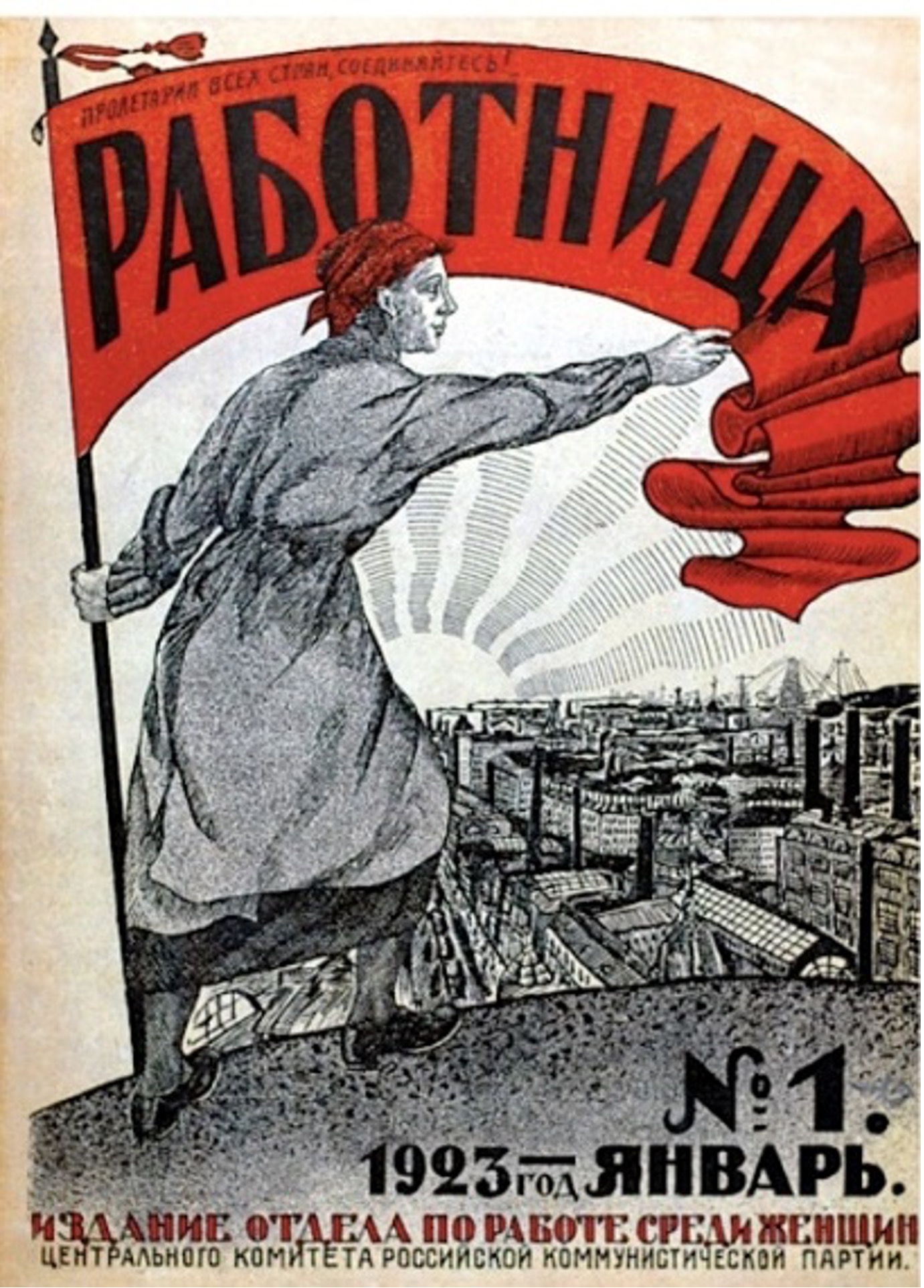
Text at the top reads: Proletarians of All Countries Unite!
Text at the bottom reads: 1923 January, Publication of the Women’s Work Department of the Central Committee of the Russian Communist Party.
The freedom given to local authorities to decide the fate of divorce could not prove helpful to women as this might imply. Discretion of a local judge enabled some to avoid complying with the divorce request. Permitting some cases of divorce left women impoverished if they had no other means of survival outside their husbands. For some women, marriage was oppressive, yet for others it guaranteed shelter and food. Emancipation for women did not always mean divorce, but the freedom to have a social or working life outside the domestic sphere. This initial failure highlighted how out of touch Lenin and his party was from the majority of the population, and how they made few attempts to understand the structure of the working-class home.
Figure 1 is the 1923 cover of a female-organised magazine titled Rabotnitsa (The Woman Worker), of which Lenin was a supporter. The paper was instrumental in promoting socialist ideas among women, aimed at female workers. On this cover, the title is displayed in a red flag, highlighting international socialism. The flag points to industry in the background, reinforcing and symbolising how women could make advancements into the workplace. Russian historian Anne Bobroff emphasises how the Rabotnitsa was the Bolsheviks’ first commitment to an official long-term contract with women. However, this was undermined by the dedication to focus on ‘women’s issues’, like maternity benefits, childcare and other domestic issues. Women were encouraged to participate within the state taking on leading roles to help build communism, but in reality, only a small minority were actually able to hold office; women of the working and peasant classes were less likely to serve as they lacked education. Therefore, women’s political consciousness evolved, but the ethos of Bolshevism remained strongly masculine.
Social Freedom?
Lenin believed that the oppression of women was a function of their exclusion from the public sphere. Elizabeth Waters argued that the Bolsheviks frequently fought to free women from housework to foster political consciousness. In a speech delivered in September 1919, Lenin proudly announced:
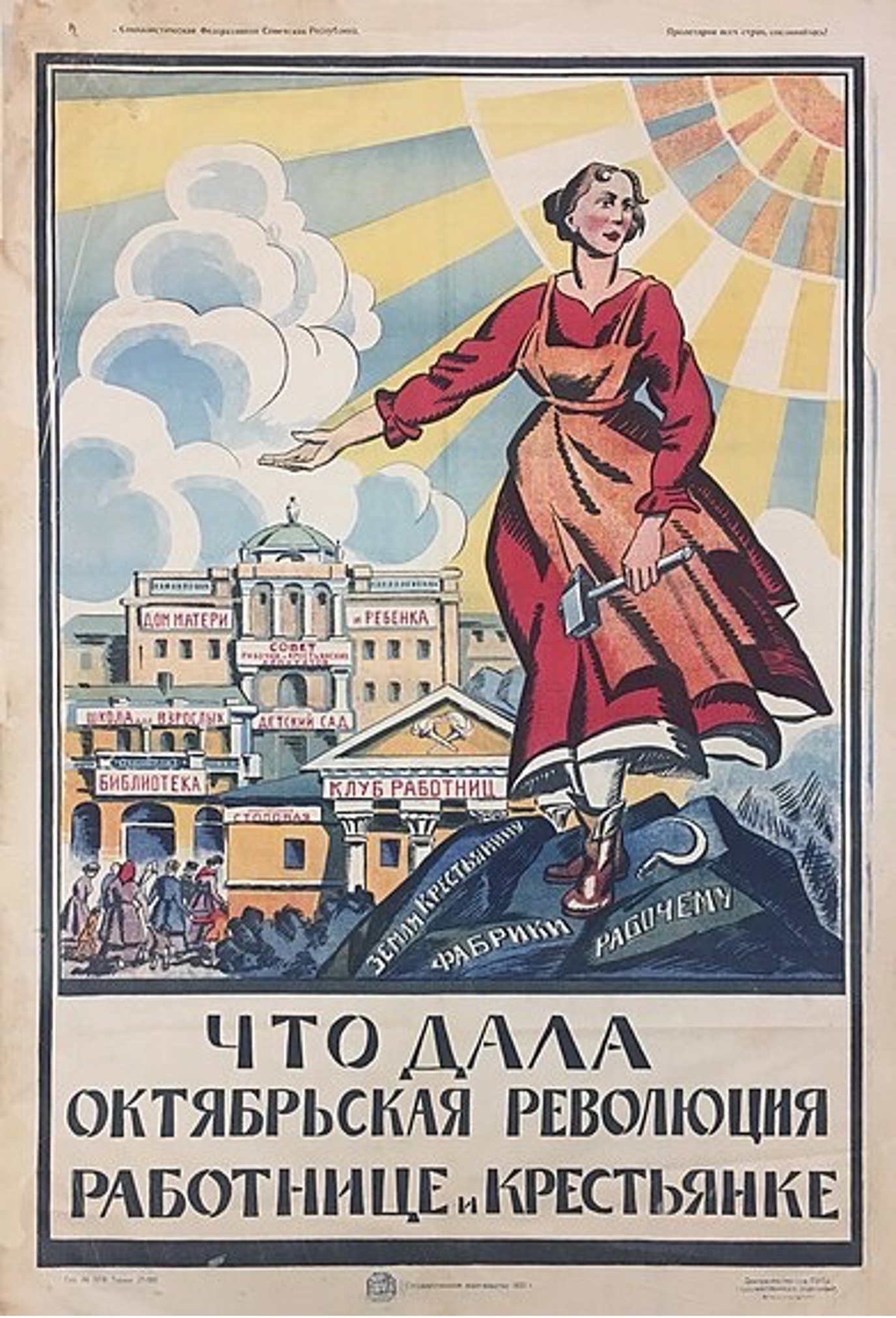
“We may now say…without any exaggeration that apart from Soviet Russia there is not a country in the world where women enjoy full equality and where women are not placed in the humiliating position felt particularly in day-today family life.” The Figure 2, “this is what the October Revolution has given to working and peasant women” is an example of propaganda that reflected this highly optimistic argument, aiming to highlight how supporting the revolution would benefit women. The title of the poster diminishes the efforts of women as active participants of the revolution, instead suggesting that women were handed these benefits rather than being recognised for their sacrifice and hardship. Figure 2, created in 1920, portrays a female worker in the foreground, suggesting that women’s advancement was a priority. The hammer in her hand and the sickle at her feet suggests she embraced communism. The sun in the top right corner shines down on the new initiatives that the Bolsheviks envisioned for women, including a “library, cafeteria workers club, school for adults and house for mother and child”. The artist has appropriated the colour red, widely associated in Russia with beauty and religion, to reflect broader connotations of international socialism. This gives the protagonist a heroic stature and manifests feelings of patriotism.
In the same speech in 1919, Lenin further stated how:
“We are setting up model institutions, dining-rooms and nurseries, that will emancipate women from housework. And the work of organising all these institutions will fall mainly to women. It has to be admitted that in Russia today there are very few institutions that would help woman out of her state of household slavery…it must be said that these institutions that liberate women from their position as household slaves are springing up wherever it is in any way possible.”
Lenin’s view here, while passionate, is confusing and hypocritical. He simultaneously believed that women should be allowed to separate themselves from the oppressive nature of housework yet expected them to be the sole organisers of these institutions. As reflected in Figure 2, the Bolsheviks envisioned a transfer of childcare to agencies outside the family. State-mandated childcare was important to support the transition into the workplace, yet the reorganisation of this was overly ambitious. It neglected to address that it would be women who worked in wash-houses and kitchens, essentially mirroring the work they already undertook. For the Bolsheviks this was not illogical, as they believed that the oppression of women was a product of their social status and isolation within the home. Encouraging women to continue the domestic roles that Lenin himself heavily critiqued is far from progressive in reality. In this case, the Bolsheviks failed to actively emancipate women from the housework they believed was so demeaning.
Economic Liberation?
A gateway to women’s progress into the workplace opened on the eve of the First World War; their support in the factories on production lines was extremely vital to supplement absent workers sent to the front. Most notably, they were cheap labour, and this was exploited, as previously seen. However, this was an opportunity for women to show their loyalty to their nation, working on the premise of equality with their male counterparts when the war ended. Lenin was the biggest critic of the role of a ‘housewife’ and condemned its oppressive nature. In a speech to the Fourth Moscow city conference of non-party working women, 1919 Lenin argued:
“…to affect her complete emancipation and make her the equal of the man it is necessary…for women to participate in common productive labour. Then women will occupy the same position as men.”
The inexpensive nature of women’s labour was taken advantage of by factory employers, especially during the desperate times of war, in which Russian women, like thousands of others globally, stepped into stereotypical male roles to compensate for their absence. The textile industry was one of the main industries experiencing militancy among their workers, evidenced by the fact that 458,000 out of 870,000 workers in 1922 were women.
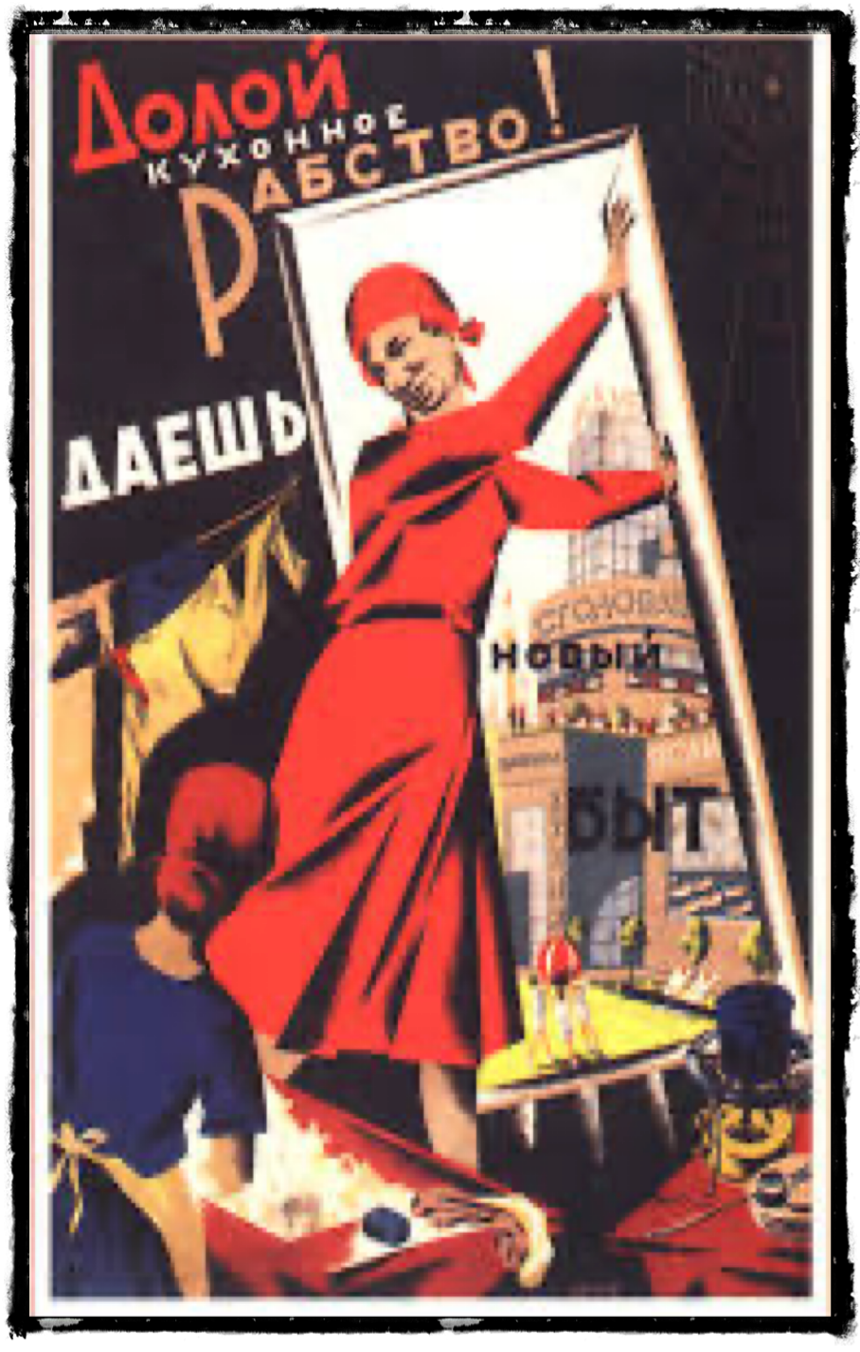
Figure 3, “Down with kitchens”, reinforces the importance of women’s progress. The woman on the right of the image is the embodiment of international socialism, dressed fully in red, fixing a poster presenting a window to the future. The women are accompanied by typical domestic work like laundry and washing up. This reflects Lenin’s speech in Moscow in 1919, where he claimed that for women to gain full equality it was necessary for “the national economy to be socialised and for women to participate in common productive labour.” This directly emphasises Lenin’s desire to integrate them into the workplace. The message behind it reinforces that women supporting the revolution evidently meant supporting their progress into the public sphere.
Concluding Thoughts
The failure to directly challenge gender stereotypes within Russian society was arguably the Bolsheviks’ biggest downfall regarding women. On the surface it would be arrogant to neglect the reforms that were introduced to give women more rights than they previously had. Legislation gave women a just cause for divorce, without considering that she would be left destitute if her husband filed a case or trapped if her own was declined. Social housing that should have provided care for her children to permit time to advance in political circles or get an education, was often never seen to completion. Economically, women made the most advancement, being able to work in industry outside of her family home. However, the threshold of the patriarchy remained strong as women typically made up the largest numbers in factories that reinforced domesticity, like the textile industry.
As seen under the leadership of his predecessor, Joseph Stalin, strong male ethos maremained the backbone of the Bolshevik party and the wider communist movement. It is clear that women’s emancipation was used as a tool to mobilise their support within the party in order for Lenin to legitimise his rule. Ultimately the Bolsheviks underdelivered on their promises and consequently only liberated women on the surface, as they failed to adequately challenge traditional societal views on gender division.
Written by Natasha Pryor
Bibliography
Primary Sources:
Kupreyanov, N.N. What did the October Revolution give to the working women and the peasant women? 1920. Multicolour lithography, 109 x 70.5. State Publishing House, Moscow. Accessed April 15, 2025. https://redavantgarde.com/collection/show-collection/1330-what-october-revolution-gave-to-female-workers-and-peasants-.html?authorId=4.
Lenin, V.I. The Tasks of the Working Women’s Movement in the Soviet Republic. Presented at The Fourth Moscow City Conference of Non-Party Working Women, September 23, 1919. https://www.marxists.org/archive/lenin/works/1919/sep/23a.htm.
Lenin, V.I. To the Working Women. Pravda, February 22, 1920. https://www.marxists.org/archive/lenin/works/1920/feb/21.htm.
“Rabotnitsa – The Woman Worker.” Marxist Memorial Library. n.d. Accessed May 23, 2025.https://www.marx-memorial-library.org.uk/project/russian-revolution/rabotnitsa-woman-worker.
Russian S.F.S.R. 1921. The Marriage Laws of Soviet Russia Complete Text of First Code of Laws of the Russian Socialist Federal Soviet Republic Dealing with Civil Status and Domestic Relations, Marriage, the Family and Guardianship. Edited by Russian Soviet Government Bureau. New York : The Russian Soviet Government Bureau.
Universal History Archive, Soviet Political Poster. Down with Down with kitchen slavery. Hurrah for the new everyday life. 1931. 20.1 x 24.9 cm. Accessed April 15, 2025. https://www.album-online.com/detail/en/YzQxODNiMA/soviet-political-poster-down-kitchen-slavery-hurrah-for-new-everyday-alb10957983.
Secondary Sources:
Bobroff, Anne. “The Bolsheviks and working women.” Soviet Studies 26, no.4 (1974): 540-567.
Clements, Barbara Evens Bolshevik Women. Cambridge University Press, 1997.
Kane, Eileen. “The Revolution’s Failed Promise to Women.” Public Books. June 26, 2018. Accessed May 24, 2025.https://www.publicbooks.org/the-revolutions-failed-promise-to-women/.
Lenin, Vladimir Ilyich. On the Emancipation of Women. 1974.
McDermid Jane and Anna Hillyar. Midwives of the Revolution: Female Bolsheviks and women workers in 1917. Ohio University Press, 1999.
Meek, Dorothea L. “A Soviet Women’s Magazine.” Soviet Studies 4, no.1 (1952): 32-47.
Read Christopher. Russia’s home front in war and revolution, 1914-22. Book 4 Reintegration – the struggle for the state. Slavica Publishers, 2018.
Socialism Today “Women and the Russian revolution.” Socialist Party Magazine. April 2017. Accessed May 24, 2025. https://socialismtoday.org/archive/207/women.html#:~:text=The%20nurseries%20and%20cr%C3%A8ches%20that,is%20once%20again%20a%20crime.
Varga-Harris, Christine. “Gender and Housing in Soviet Russia: Private Life in a Public Space.” Review of Gender and Housing in Soviet Russia: Private Life in a Public Space. Reviews in History 988 (2010): 1-6. Accessed May 24, 2025. https://reviews.history.ac.uk/wp-content/uploads/pdf/Reviews_in_History_-_Gender_and_Housing_in_Soviet_Russia_Private_Life_in_a_Public_Space_-_2010_11_01.pdf.
Waters, Elizabeth. “The Bolsheviks and the Family.” Contemporary European history 4, no.3 (1995): 275-291.