Field to Facade: What the eighteenth-century architecture of West Street in Farnham, Surrey, can reveal about the local economy and class culture in that period.
The town of Farnham in Surrey is home to an impressive number of eighteenth-century townhouses, many of which can reveal a significant degree of information about the town at the time. Fundamentally, the eighteenth-century architecture of West Street can reveal the extent to which the hop trade came to dominate the local economy. Using a number of case studies, it is possible to reveal how the growth of this industry defined the accumulation of wealth among select local families. These families were consequently able to exhibit their newfound prosperity through the construction of large townhouses on West Street with fashionable Georgian and baroque facades of the stylish and high-class architectural language of the time.
This article focuses on West Street in central Farnham because a history of remodelling parts of the town’s centre – such as the construction of 1930s neo-Georgian shopfronts on Castle Street and unfortunate 1960s brutalist developments on East Street – has isolated most of the town’s authentic and exemplary eighteenth-century architecture to the west.
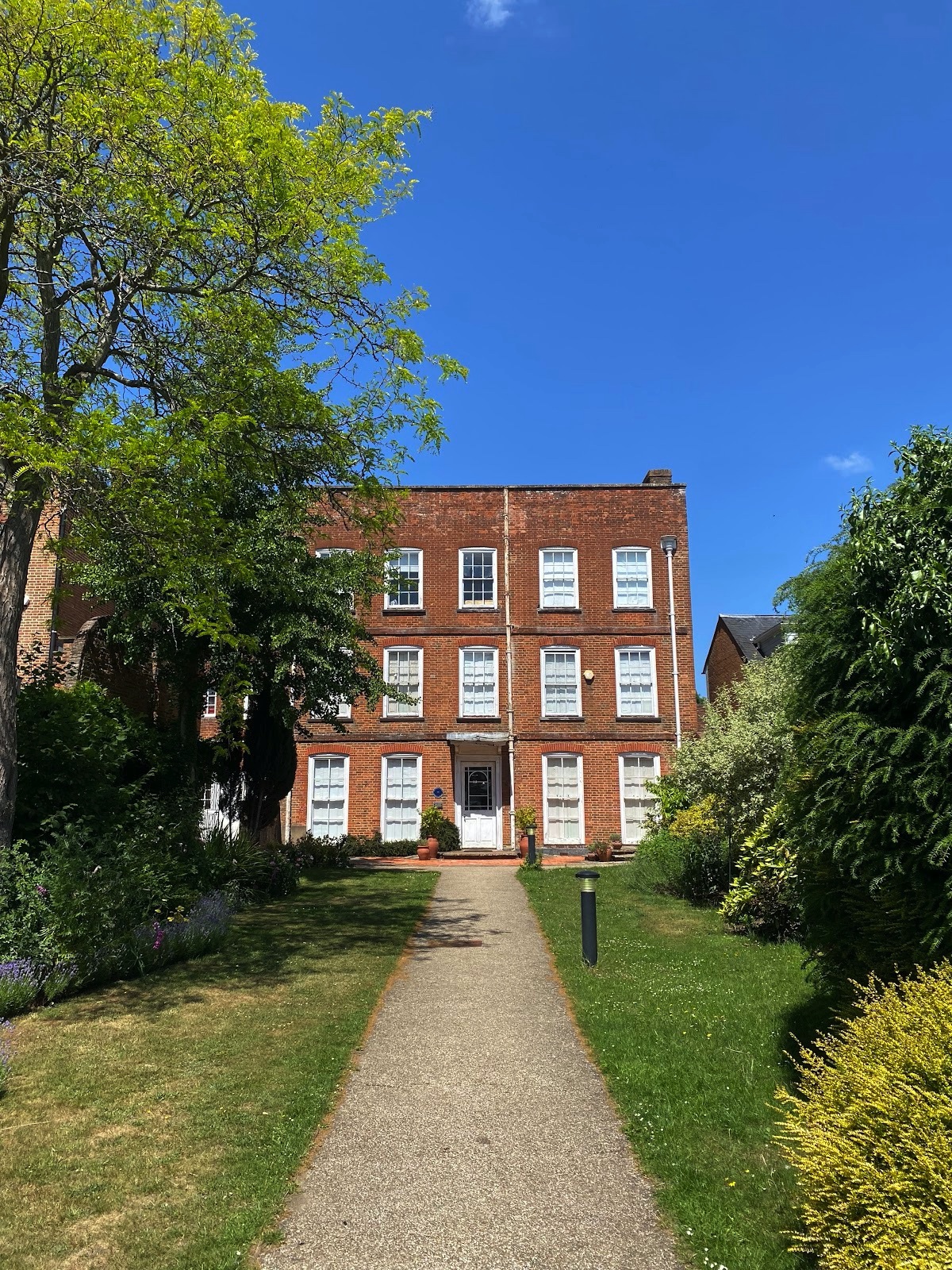
Preceding Local Industries and the Growth of the Hop Trade in Farnham
By the beginning of the eighteenth century, Farnham had already developed a strong reputation for agricultural produce and a thriving market scene. In the 1720s, the writer Daniel Defoe considered Farnham to possess the greatest cornmarket outside of London, particularly due to the quantity of wheat sold daily at the market. A market of such quality brought Farnham considerable wealth, as did other industries such as tanning. Such industries influenced the local vernacular architecture, particularly evident in the sixteenth-century raised market hall constructed at the bottom of Castle Street in 1566.
The hop trade, which exploded in the eighteenth century, eventually eclipsed many preceding industries and led to the rapid accumulation of remarkable wealth, consequently leaving a significant impact on local architecture in that period. For example, by the end of the seventeenth century, there were estimated to have been around three hundred acres of land in and around Farnham used for hop production, yet by the end of the eighteenth century, that acreage had more than tripled. The hop industry grew so quickly in this period, and so much wealth was accumulated through it, that the existence of other local industries, particularly tanning, have since been historiographically overshadowed.
Hops grown in Farnham gained a reputation for being of a particularly high quality, and thus the industry became very alluring to prospective local hop growers, despite the precarious and unreliable nature of hop growing. The Farnham White Bine Hop was among the most renowned and highest quality, allowing hop growers to turn considerable profits in their production. The expansion of the hop industry in Farnham also infected the nearby villages, which comprised the old Farnham Hundred (the local county subdivision dating to Anglo-Saxon times): it is noted that almost all hop-growing land in the nearby Wrecclesham was owned by wealthy residents who lived in Farnham. Therefore, it is unsurprising that the hop trade, through its scale and acceleration in the town, influenced the construction of numerous local townhouses in contemporary architectural styles throughout this period.
The Buildings on West Street
Many of the buildings on West Street are eighteenth-century townhouses, which were purchased with wealth generated through the prosperous hop industry. I will discuss two examples of these – 39 West Street (Sandford House) and 88 West Street (Bethune House) – and examine how they reveal the staggering extent to which the hop industry dominated the local economy, as well as what this communicates about the new emerging middle class culture in the area at the time.
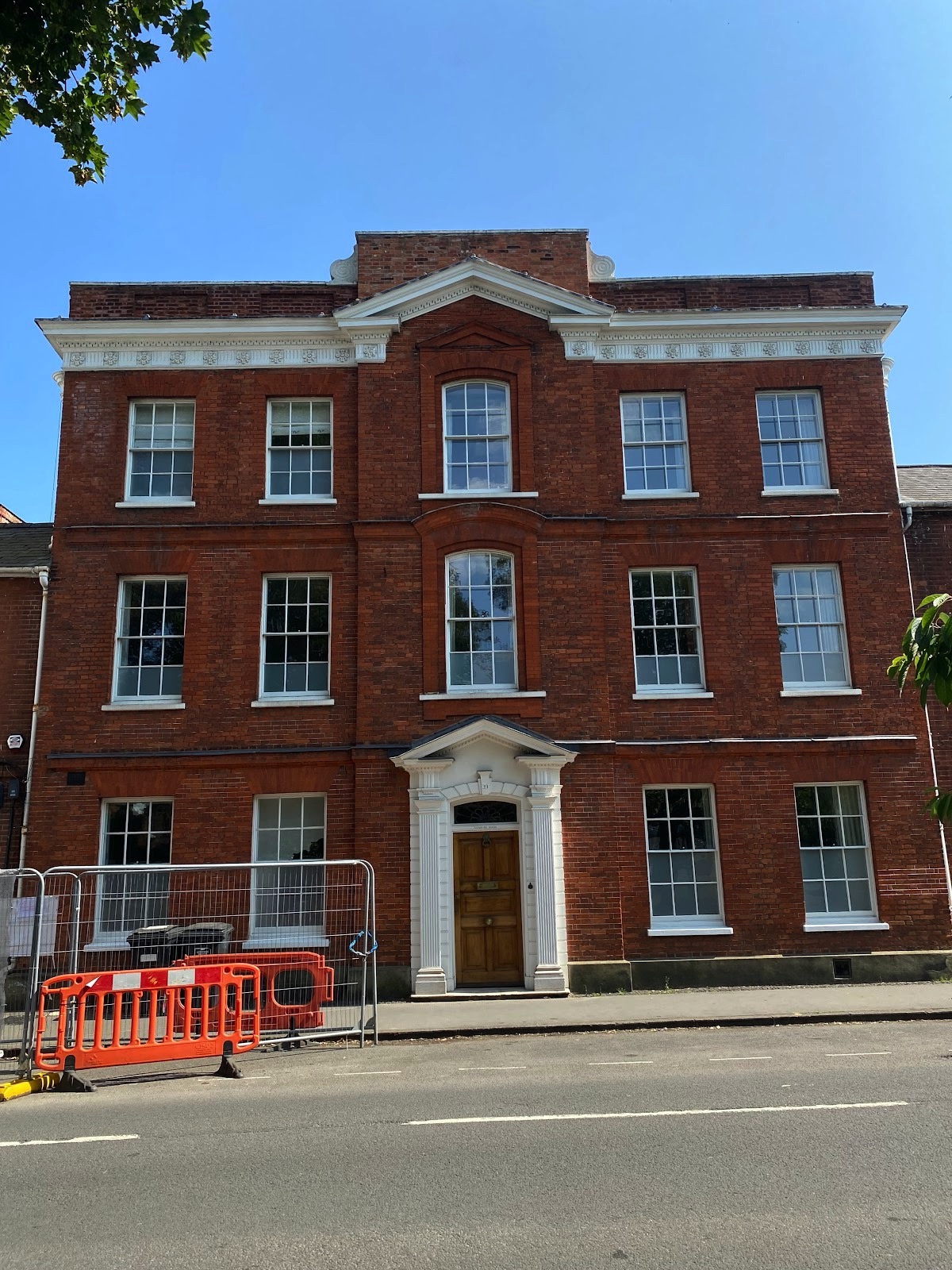
Sandford House, 39 West Street
Regarded by Sir Nikolaus Pevsner as stylistically reflecting ‘the very end of provincial Baroque, Sandford House is an exemplary eighteenth-century hop-growers’ townhouse in Farnham. The house has a symmetrical facade and is dissected horizontally by two rows of moulded brick running above the windows. At the roof there is a stucco frieze decorated with rosettes and triglyphs, above which there is a panelled brick parapet which hides behind it five small pitched roofs: stylish at the time thanks to a 1707 ban on visible tiled roofs. The central bay is set forth slightly, containing a doorway defined by its fluted Doric pilasters on each side, bridged together above the door by an open-based triangular pediment. The arch above the door itself is keyed. All windows are of the sash variety and the central bay is topped by an open-based triangular pediment of stucco.
Built in 1757, Sandford House was initially occupied by the family of John Manwaring. Although historically tanners, by the end of the eighteenth century, the family had become prominent local hop growers. The case of the Manwarings reflects the scale and speed of the growth of the hop industry in Farnham. For example, in the 1720s, John Manwaring still worked as a tanner and in 1723, the family owned two tanyards, two barns, one malthouse and one messuage, alongside some pastureland and meadows. Yet by the time of the death of John Manwaring’s son in 1794, the family owned four tanyards, two malthouses, ten messuages, and an impressive thirty-six acres of hop-growing land. Much of this land was bought in the nearby village of Wrecclesham. Hence, this reveals the scale and speed of the hop trade’s growth in eighteenth-century Farnham, as the Manwarings became less involved in the declining tanning industry and increasingly well-entrenched in the money-making hop-growing trade, allowing them to construct Sandford House. In fact, with their hop-growing wealth, the Manwarings were able to afford several other townhouses as well which were themselves often used for the production of hops. For example, it is noted that 75 West Street (with its adjoining hop kilns) had been bought by the Manwarings by 1823.
We can therefore place the Manwaring family into the category of a middle class which was becoming increasingly wealthy through hops and manifesting itself in the construction of townhouses like Sandford in the fashionable baroque style. The fact that Sandford looks as it does today – defined by architectural motifs characteristic of eighteenth-century facades in London and elsewhere, particularly those of the architect James Gibbs – reveals that families in Farnham were not only acquiring significant wealth through the hop trade, but also seeking to emulate the culture of the middle and upper classes in London. Much of this classical architectural style was brought to England by the upper classes returning from Europe, where they had seen buildings like those of Andrea Palladio in Italy who drew upon ancient Greco-Roman motifs and principles. As much the case for Sandford House as it is for the neighbouring Willmer House (Fig. 1), contemporary Palladian architectural trends found their expression in Farnham’s townhouses, as families like the Manwarings sought to conform to the high-class fashions of the time.
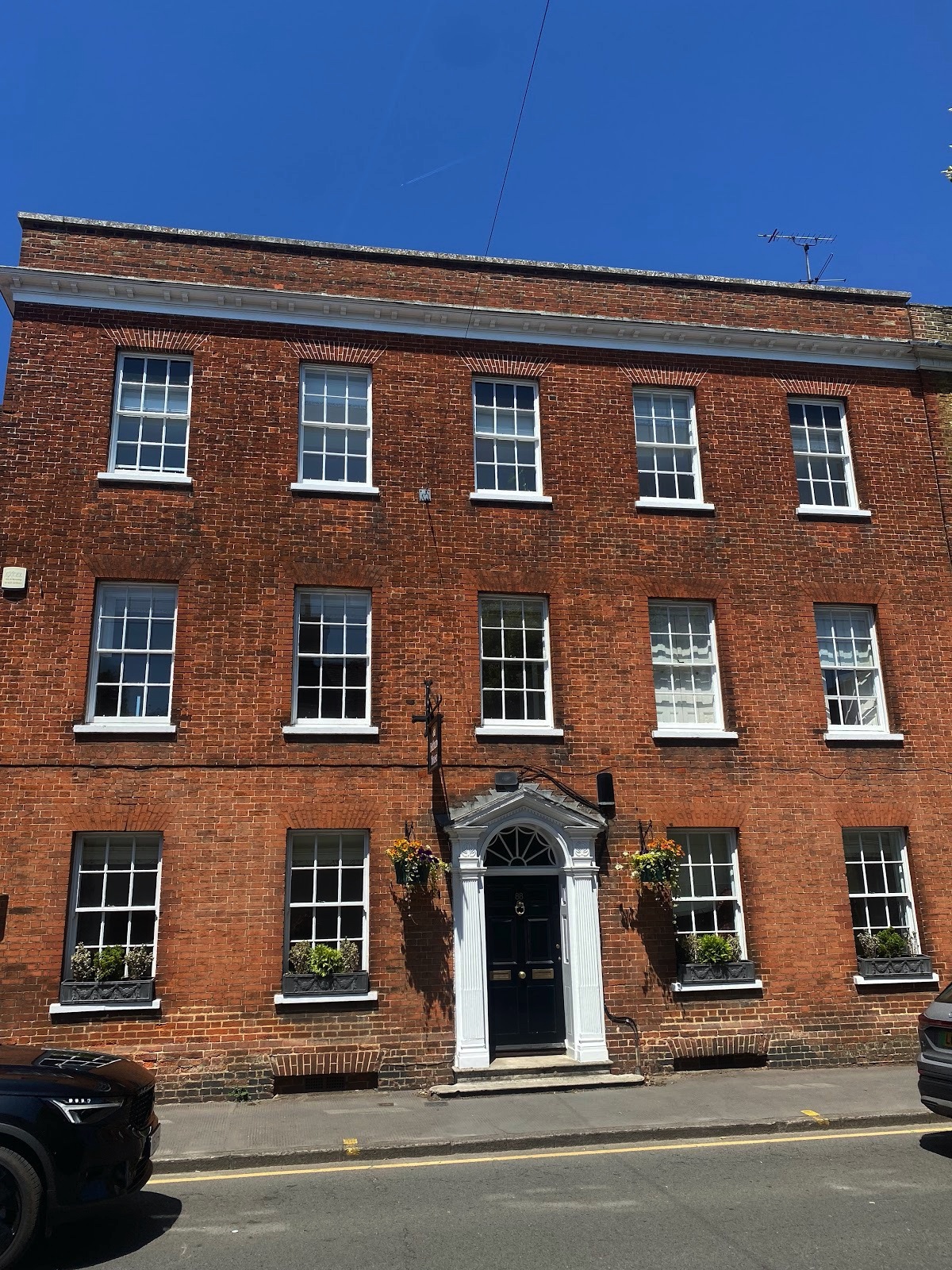
Bethune House, 88 West Street
On the opposite side of West Street is Bethune House. Seen in Figure Three, the building has a more traditional Georgian-style facade than Sandford, five by three bays of characteristic sash windows and a central doorway on the lower central bay. This doorway is very similar to that of Sandford House, with two fluted Doric pilasters either side of the door and an open-based triangular pediment above, although with a radial semicircular fanlight window between the door and the pediment. Pevsner and Nairn call the numbers 88-94 West Street ‘English eighteenth-century townhousing at its very best.’ Bethune House was built in around 1780 for William Shotter, a lawyer and the last bailiff of Farnham. This house highlights two notable aspects of Farnham’s economy in this period.
First, it reveals the extent to which the profitability of hops influenced land use in the town itself. I have mentioned that the Manwaring family owned townhouses which incorporated hop kilns, but it should be noted that hop growing was also carried out in the grounds of the houses on West Street. Before the southern part was enclosed in 1871, the rear of Bethune House looked onto Garden Piece – a fruitful hop ground which included a house, barn, malthouse, and stable by the early eighteenth century. Hence, it would appear that land in central Farnham was used for hop growing as well as kilning.
Secondly, examination of the house’s owners – the Shotters – reveals the nature of hop growing as a career within the local economy. William Shotter was a lawyer, as was his nephew, James Shotter, who kept a solicitor’s practice in the house until as late as 1852. This suggests that hop growing was often a secondary career, with successful hop growers like the Shotters simultaneously holding separate professions, such as law. Another example of this might be the Elmer family (after whom 41 West Street is named) who, despite being a prominent hop growing family, were also painters. Therefore, for many wealthy families in Farnham, eighteenth-century hop growing was what we might now call a ‘side hustle’ – and a very profitable one at that.
Bethune House continues to highlight the architectural trends of the period with which the wealthy families who owned the house sought to conform. The house’s Georgian style reflected Palladian architectural trends in London and Guildford, such as its symmetrical facade and rooftop cornices. Such features conformed closely with accepted architectural manners of the time, once again drawn from the Grand Tour trends brought to England from Italy and Greece by the upper classes. This reminds us that buildings like this were as much fashion statements as they were functional places for living.
Conclusion
I have attempted to illustrate how the eighteenth-century townhouses which adorn West Street in Farnham can be used to reveal the extent to which the hop industry dominated the local economy. This has been done through the examination of the families for whom the houses were constructed: those who owed a large proportion of their wealth to the growth and kilning of hops. Consequently, I have also sought to demonstrate that the eighteenth-century townhouses on West Street present a dialogue between new-found hop wealth and class aspirations, with families such as the Manwarings and Shotters seeking to conform to the architectural fashions brought to England by upper classes returning from their Grand Tours. Thus, the eighteenth-century townhouses of West Street can reveal a significant degree of information about the nature of the local economy and class culture in the period.
Fundamentally, we should remember that architecture and the built environment provide a vital lens through which we can perform historical analysis, and which signify to the present aspects of the historical past. In using architecture as a historical tool we are able to appreciate the importance of time and place in the chronology of local history: if the hop trade had not exploded in Farnham in the eighteenth century, the town would not have aligned with the prevailing architectural fashions that it did, meaning that West Street could have looked completely different to how it does today.
In sum, architecture is a poignant tool for local history and one which creates a tangible means of engaging with local heritage in a way that aligns closely with our lived experience as residents of the communities in question.
Written by Thomas Cowell
Bibliography
Birch, John. The History of Wrecclesham. S.l.: Self-published, 2024.
Defoe, Daniel. A Tour thro’ the whole island of Great Britain, divided into circuits or journies. London: JM Dent and Co., 1927.
Heather, Pat. The Town of Farnham: A History of West Street. Farnham: Farnham and District Museum Society, 2019.
Information about the Market Hall. Plaque, Town Hall Buildings, Castle Street, Farnham, United Kingdom. Accessed 18 June 2025.
Museum of Farnham. “The origin of our Georgian house.” Farnham: Museum of Farnham, 2025.
Nairn, Ian and Pevsner, Nikolaus. The Buildings of England: Surrey. London: Yale University Press, 2002.
Riseboro, Bill. The Story of Western Architecture. London: Herbert Press, 1997.
Temple, Nigel. Farnham Inheritance. Farnham: The Herald Press, 1965.
Temple, Nigel. Farnham: Buildings and People. Chichester: Phillimore and Co., 1973.