Exodus or Homecoming?: An Exploration of Nationality in the Greek-Turkish Population Exchange
The 1923 population exchange was perhaps one of the most important events in modern European history. Its enactment was not only significant for the peoples of Greece and Turkey, but also a template by which the nationalistic aims of European leaders would be realised across the 20th century. The aim of this article is to explore the ideas and principles that governed such a decision. Through a combination of state and international authority, over one and a half million people were forcibly removed from their ancestral homes in exchange of populations that aimed to homogenise the populations of Greece and Turkey. This scheme aimed to create distinct Greek and Turkish identities, crude categorisations that were often synonymous with religious affiliations of Christian or Muslim. Indeed, as this article aims to show, these conceptions of ethnicity would have disastrous consequences for the refugees of Anatolia; ones that still define the makeup of Greece and Turkey today.
The Road to Lausanne
For many in the Western world, the horrors of World War I ended on the 11th of November 1918 with the signing of the Treaty of Versailles, yet this proclamation of peace rang hollow for other parts of Europe. Indeed, in the five years preceding 1918, a number of conflicts brought destruction on a scale equal to, or even greater than the First World War itself. The Russian Revolution, Irish War of Independence and Greco-Turkish War would come to define a period that was supposed to symbolise an end to fighting across Europe. Unsurprisingly, the last of these played a pivotal role in formulating the conception of the population exchange.
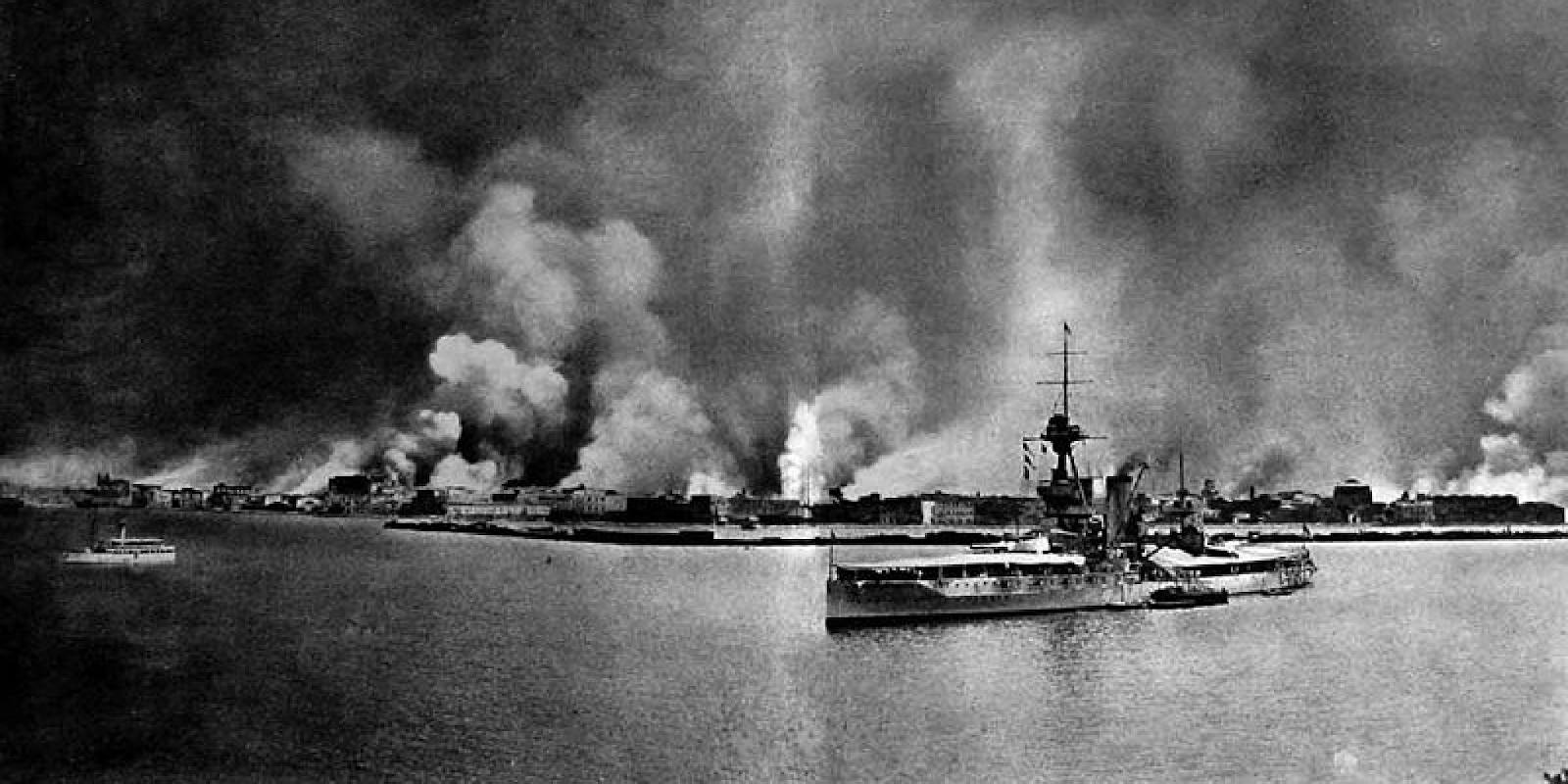
In 1920, following the collapse of the Ottoman Empire, the Greek state looked to expand its influence into central Anatolia. As their army swept through these territories, Ottoman Christians, who had long suffered under the empire, took this opportunity to enact vengeance on their former Turkish overlords. Throughout western Anatolia, Greek soldiers and civilian militias, committed atrocities upon local Turkish populations. In the town of Turgutlu, estimates vary from 10,000 to 31,000 civilian deaths, with over 90% of the city destroyed. However, as the tide of war shifted in favour of the Turkish army in late September of 1921, Turkish soldiers returned this hostility to the Christian population. With the war finally coming to a close in the final months of 1922, one of the greatest tragedies of the war took place in the Aegean port city of Smyrna; a fire of contested origins broke out and took the lives of some 100,000 people.
A New World Order
Between all this fighting, the victorious powers of the First World War had been seeking a permanent solution to peace in Europe. In 1920, France, Britain, and other allied nations founded the League of Nations with the aim of resolving and preventing future conflict. The first real test of this organisation would come following the decisive victory of the Turkish Army over the Greeks. As the Turkish nationalists, led by Mustafa Kemal Atatürk, set to work building their new state, it soon became clear that there was no room for the Christians of Anatolia within this framework. Thus, a new humanitarian crisis grew as the Turkish government began forcibly removing its unwanted population.
Eager to prove its worth on the international stage, the League of Nations called for negotiations. Here, Britain, France and the U.S would play a decisive role in engineering a permanent solution by which the Greek population of Turkey, and Turkish population of Greece, approximately one and a half million people, would be exchanged. As described by the head of the League, Fritjof Nansen, this would constitute an “unmixing of populations”, that the League believed was vital to upholding social and international order. Thus with the signing of the Treaty of Lausanne on July 24th, 1923, the final shots of the First World War rang out; and with it, the fate of one and a half million people was sealed.
Who goes where?
Far from the ethnic-homogeneity the League stressed, these arbitrary categories of Greek and Turk revealed the crude reality of the League’s solution. In particular, Greek and Turk had become synonymous terms for Christian and Muslim; definitions that ignored vital cultural distinctions such as language and community. While many of the exchanged population of Turkey may have identified as Christian, the extent to which they could be considered Greek is limited. Some spoke the language of the new country very well, others with an accent or not at all. Indeed, many of these people spoke Turkish, exercised Turkish customs, and had no desire to return to a homeland they had never been to. Yet, their religious affiliation was deemed reason enough to consider them ethnically Greek.

Within this limited space for identity, there was little room for conceptions that fell outside simple categorization. As a result, many groups of people who identified as neither Greek or Turkish fell through the cracks of the exchange. In particular, the Cappadocians, Christians in central Anatolia, were particularly difficult to classify. Though these people retained a number of Greek customs throughout Ottoman rule, they predominantly spoke in Turkish, and utilised a hybrid form of writing known as Karamanlidika that employed both languages. Clearly, this group of people were ethnically distinct from the broad classification of Greekness that the League employed, yet, since no party in Lausanne was prepared to put up a diplomatic fight to let the Cappadocians stay in their homes, they were forced to leave.
Greece for Greeks?
Even when these refugees did arrive at their supposed homelands, the reception was mixed at
best. In some cases, often small communities, refugees were welcomed by locals. However, in larger population centres such as Athens, the sheer volume of the displaced was too much to accommodate, leading to significant tensions with the locals. In particular, many natives in Greece came to address the Anatolian refugees as “the Turkish seed,” or offspring, Turkos sporoi. Likewise locals in Turkey called the incoming Muslims “the Greek seed,” Yunan dölü. While the incoming population was mostly Orthodox Christian, they were heavily diversified in a number of other aspects such as wealth, language and dialect.
In spite of the League’s crude categories of Christian and Muslim, regional stereotypes also played an important role regarding the treatment of refugees. As recalled by British academic Carlile Macartney in ‘Refugees: The Work of the League,’ published in 1931, “The Greeks of the coast were ‘true Ionians in their individualism, their gaiety, energy, suppleness of mind,” whilst Thracians and Bulgars were described as “slow and serious and of regular habits.” Macartney’s views on the refugees highlight important attitudes that governed the work of the League. In particular, the categorisation of Anatolian refugees as rural or urban through these stereotypes determined where they were settled and what kind of aid they received. For those deemed part of the urban class, some 30%, many were settled in affordable housing within reach of public services. Yet, for the overwhelming majority, the allocation of a rural lifestyle often led to significant hardships, with little to no help beyond a mud-brick cottage, a few tools, and a donkey.
Songs for Home
Despite the attempts of the League to categorise, and erode identity, refugees continued to exercise agency, of which culture was an important medium. In the case of Anatolian Greeks, the rebetiko musical style was maintained as a connection to their old home. Indeed, refugee musicians dominated the commercial recording of popular songs in Greece throughout the interwar period. In this way, rebetiko was a significant form of resistance to the ideas of ethno-nationalism that defined the population exchange. Yet, rebetiko would soon come to perpetuate many of the stereotypes that had informed the exchange.

As the Greek government pushed to assimilate its refugees, rebetiko music was appropriated by those seeking to establish a new understanding of the Anatolian homeland. By the 1930s, much of the genre’s lyrics could be seen to represent the East as a fairy-tale setting full of carnal temptations, recreational drugs, and opportunities for enrichment and leisure among compliant hordes of subjugated women. Refugee women in particular were made to appear seductive, coquettish, but ultimately vulnerable and available, so that their courtship, or rather conquest, becomes a sport for predatory local males. In this way, rebetiko shared a similar fate to refugees themselves, as they were slowly incorporated into a strictly Greek national framework.
Closing Thoughts
Through the experience of the Anatolian Greeks, it is clear that the interwar period was a time of intense categorisation, in which many millions would suffer as a result. Viewed from above, these experiments at nation-building seemed to elevate cultural and ethnic identities. However, on the ground, from the level of everyday life and social interaction, it uprooted families and destroyed existing patterns of local life, language, and culture. Today, the legacies of the exchange still live on through ruined mosques in Greece and hollowed cathedrals in Turkey. In extreme cases such as the Turkish town of Kayakoy, the majority of
homes and businesses remain abandoned since their inhabitants fled over 100 years ago. Their decay is an apt metaphor for the slow disintegration of ties that used to hold the communities of Greece and Turkey together. When the Aegean people were prised apart, each lost a part of its own identity, and hence the ability to understand itself.
Written by Max Hillier
Bibliography:
Images:
Photo from the film ‘Rembetiko’ (1983). Best of Athens. Accessed July 5, 2024.
https://www.bestofathens.gr/article/rebetika
The Great Fire of Smyrna. Illinois Holocaust Museum and Education Center. Accessed
July 5, 2024.
https://www.ilholocaustmuseum.org/events/the-great-fire-of-smyrna-the-genocide-of-greeks-in-asia-minor-remembered-100th-anniversary-commemoration/
Refugees on board two boats heading for Constantinople. ICRC Archives, International
Committee of the Red Cross Files. Accessed July 5, 2024.
https://blogs.icrc.org/cross-files/an-icrc-delegate-alone-at-the-heart-of-the-greco-turkish-war-1919-1923/.
Photo of Kayaköyü. Wikipedia. Accessed July 5, 2024. https://en.wikipedia.org/wiki/File:Kayak%C3%B6y%C3%BC.jpg.

Primary Sources:
Macartney, Carlile A., Refugees. The Work of the League. Geneva, Switzerland: The League
of Nations, 1930.
Secondary Sources:
Clark, Bruce. Twice a Stranger: The Mass Expulsions that Forged Modern Greece and
Turkey. Cambridge, Mass.: Harvard University Press, 2006.
Gauntlett, Stathis, “Between Orientalism and Occidentalism: The Contribution of Asia Minor
Refugees to Greek Popular Song, and its Reception,” in Crossing the Aegean: An Appraisal
of the 1923 Compulsory Population Exchange between Greece and Turkey, eds Renée
Hirschon, 247-260. Oxford: Berghahn Books, 2003.
Halstead, Huw, “Greeks without Greece’: Local Homelands, National Belonging, and
Transnational Histories amongst the Expatriated Greeks of Turkey.” PHD diss., University of
York, 2016.
Iğsız, Asli, Humanism in Ruins Entangled Legacies of the Greek-Turkish Population
Exchange. Stanford University Press, 2018.
Romero, Kyle E., “A Productive Asset for the Country:” Refugees, the League of Nations,
and the Greco-Turkish Exchange, 1924 -1930,” Migration Letters 20, no. 1 (2023): 1-10.
Rodogno, Davide, Night on Earth, A History of International Humanitarianism in the Near
East, 1918–1930. United Kingdom; Cambridge University Press, 2022.
Shields, Sarah, “The Greek-Turkish Population Exchange: Internationally Administered
Ethnic Cleansing,” Middle East Report 43, no. 267 (2013): 2-6
Pingback: Alaçam Mübadele Müzesi – .TR